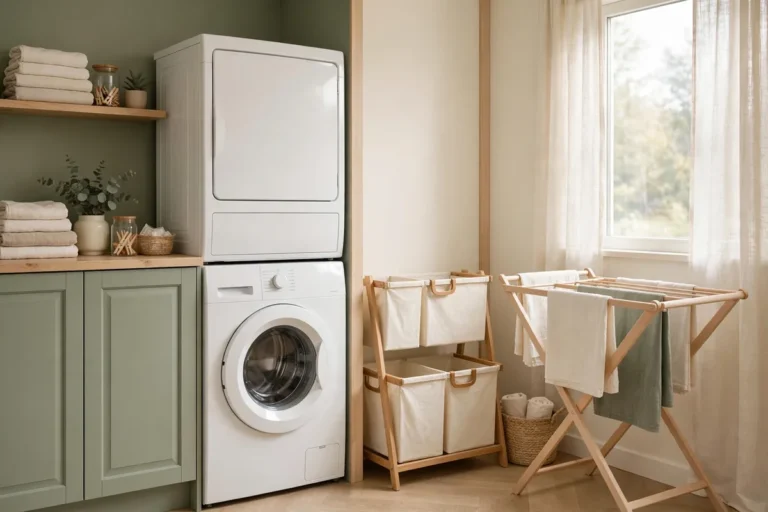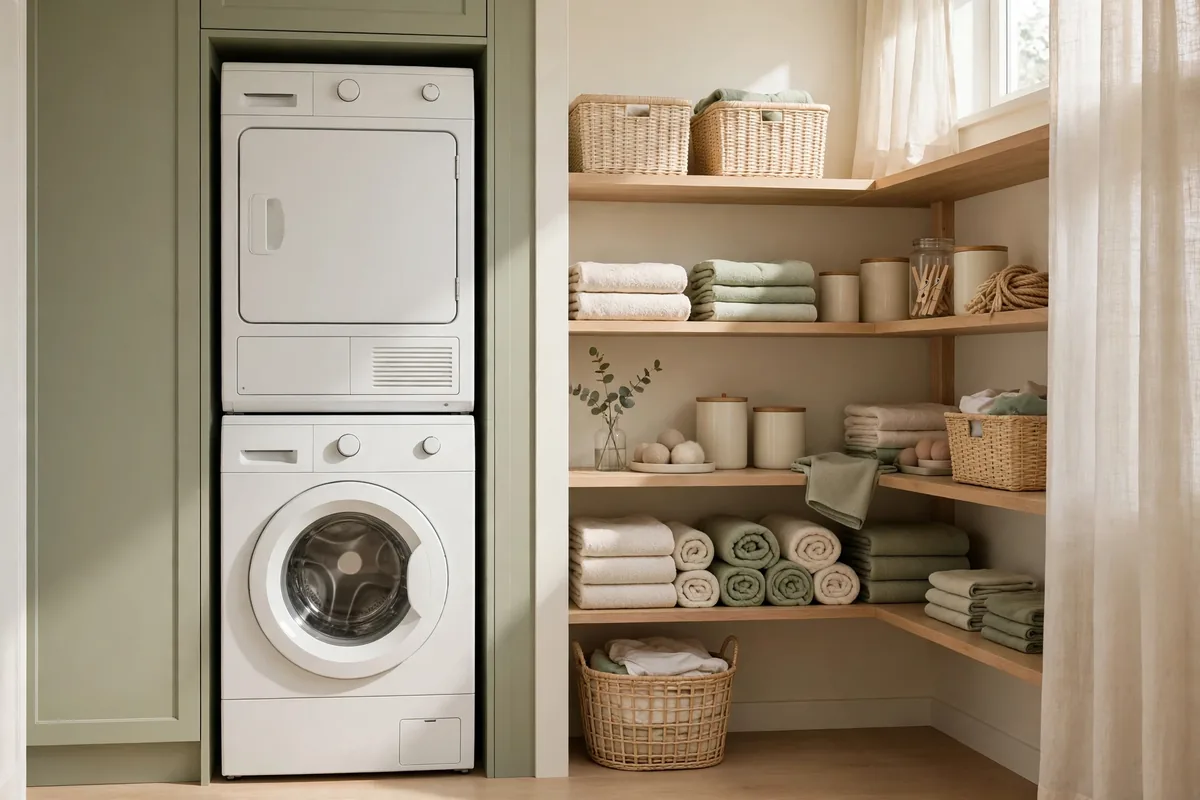
The first time I lived with a stacked washer and dryer, they were tucked into a hallway closet barely wider than the machines themselves. I learned the geometry fast: the dryer door swung exactly into the closet door, the detergent lived on the floor because there was nowhere else, and reaching the dryer’s top controls meant standing on tiptoe. It was a closet doing a room’s job in a room’s footprint.
Laundry closets are their own discipline. The machines are stacked or squeezed side by side, the doors have to close, and every inch around the units matters. This guide covers eleven ideas built for that exact footprint: access, ventilation, sound, and storage in the gaps. Here is how to make a closet-sized laundry actually work.
Measure the Closet Before You Buy Anything

Laundry closets punish guessing. Before you buy a single organizer, measure the interior width, depth, and height, the door swing, and the clearance around each machine. Write the numbers on your phone. Every product in this guide lives or dies on half-inch differences, and closets are where “standard size” goes to be wrong.
Measure with the doors closed too. The usable depth with bi-fold doors shut is often two inches less than with them open, because the folded panels eat interior space. Anything you install has to clear the doors in every position, not just the one you measured.
Note where the vents, hoses, and outlets are. The back six inches of most laundry closets belong to the dryer vent and water lines, and nothing you install can pinch those. A crushed dryer vent is a fire hazard, not an inconvenience.
Stack Smart: Shelving Beside and Above
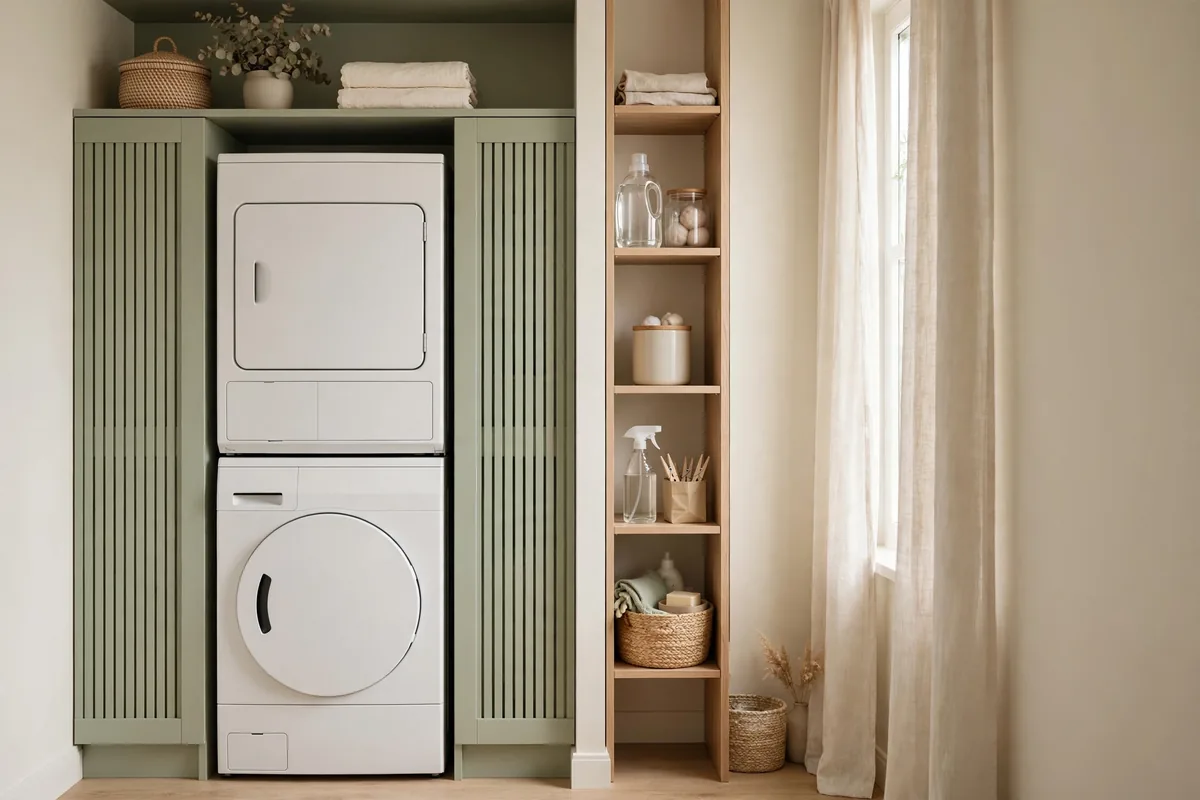
With stacked units, the wall space beside the machines is your storage. A narrow shelving tower or a set of wall-mounted shelves sized for tight vertical spaces ($25 to $40) in the 6-to-12-inch gap beside the stack holds detergent, dryer sheets, and stain treatment at arm’s height. Above the stack, one shelf near the ceiling takes the backups and the rarely used items.
Keep daily supplies between waist and shoulder height. Reaching over a stacked dryer for the detergent every load gets old fast, and the top shelf is for the things you touch monthly, not daily. Zone the shelves by frequency and your back will thank you.
The Gap Cart Fits Closets Too
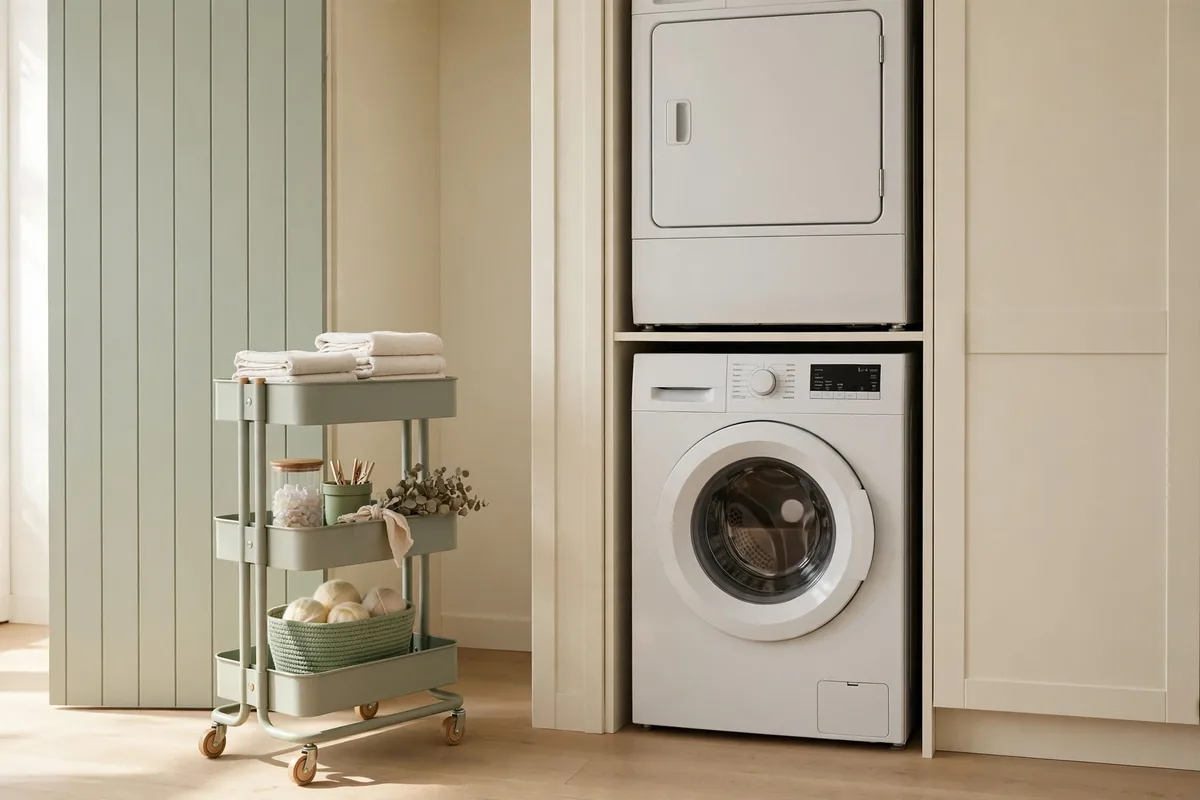
That slim rolling cart ($25 to $35) from full-size laundry rooms earns its keep in closets too. The gap beside a stacked unit is usually 6 to 8 inches, which is exactly what these carts are built for. Roll it out to grab the stain stick, roll it back to close the doors.
Choose a cart with a handle or a lip on the front. In a closet you pull the cart toward yourself in a tight space, and a cart with nothing to grip tips its contents onto the floor. The handle is a small feature that matters enormously in a 3-foot-wide closet.
Keep the cart’s top tier clear enough to close the doors. It is easy to stack the cart one item too tall and discover the bi-folds will not shut. Load it, close the doors, and adjust once. After that the height limit is automatic.
Let It Breathe: Ventilation Basics
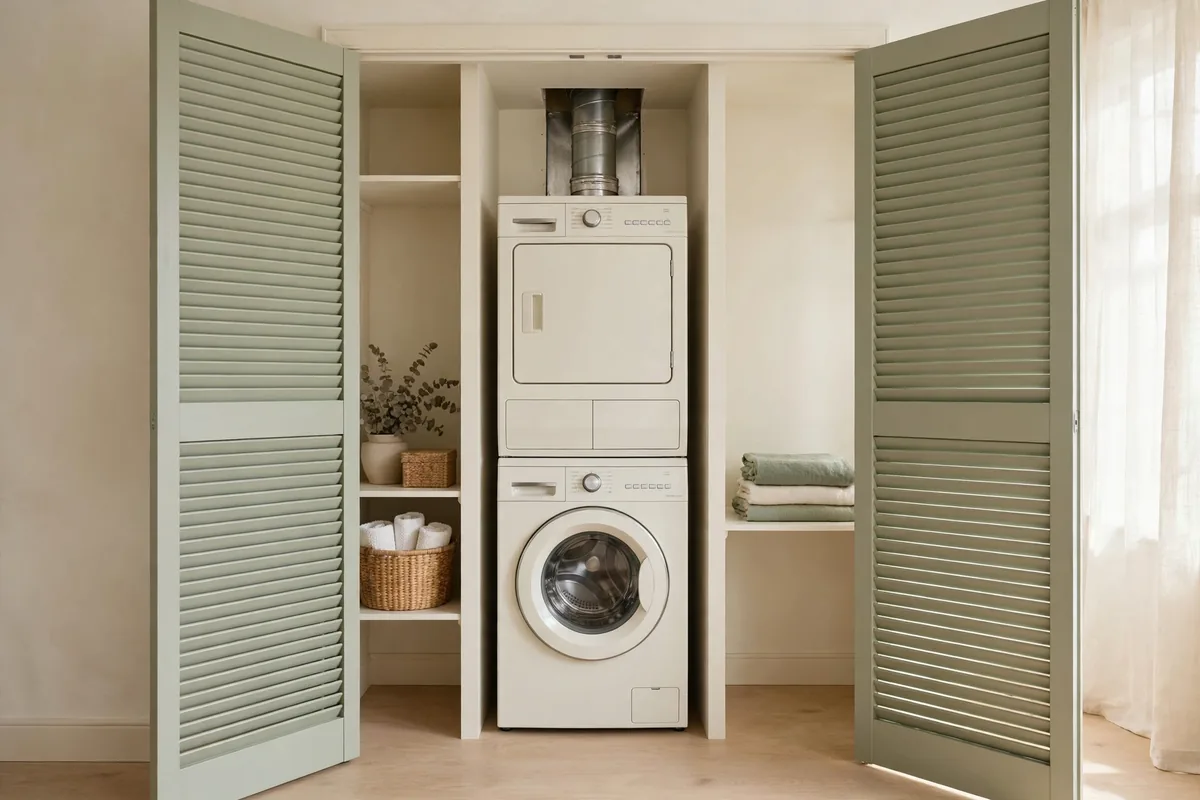
Laundry closets trap heat and moisture, and machines need airflow. If your closet has louvered or vented doors, keep them that way and never block the slats with storage. If the doors are solid, get in the habit of leaving them open during and after every cycle until the machines cool.
A small humidity problem becomes a big mold problem in a closed closet. If the walls feel damp after laundry day, add a tiny rechargeable dehumidifier ($20 to $30) on the shelf. Bathrooms fight the same moisture battle — see organizing a small bathroom for more damp-proof storage tricks. It is silent, needs no outlet, and you recharge it every few weeks. Check the closet walls seasonally for any musty smell, which is the early warning.
Never store anything against the dryer vent or the back of the machines. Vents need their full clearance to exhaust heat safely, and lint plus heat is the combination every fire safety guide warns about. Keep the vent path visibly clear, always.
Tame the Noise and the Shakes

A washer in a hallway closet announces every spin cycle to the whole house. Anti-vibration pads ($15 to $25 for a set of four) under the machine’s feet cut the rumble dramatically, and they take ten minutes to install with the machine rocked gently onto each pad. They also protect the floor, which matters in a rental.
Balance the load habitually. An unbalanced washer shakes no matter what it sits on, so distribute heavy items around the drum instead of dumping them in one clump. If the machine walks, the pads cannot save it; the loading can.
Close the closet doors during the spin cycle. It sounds obvious, but doors cut more noise than any pad. If the doors rattle, a strip of adhesive foam weatherstripping on the frame silences them for about $5.
Bi-Fold Door Backs for Supplies
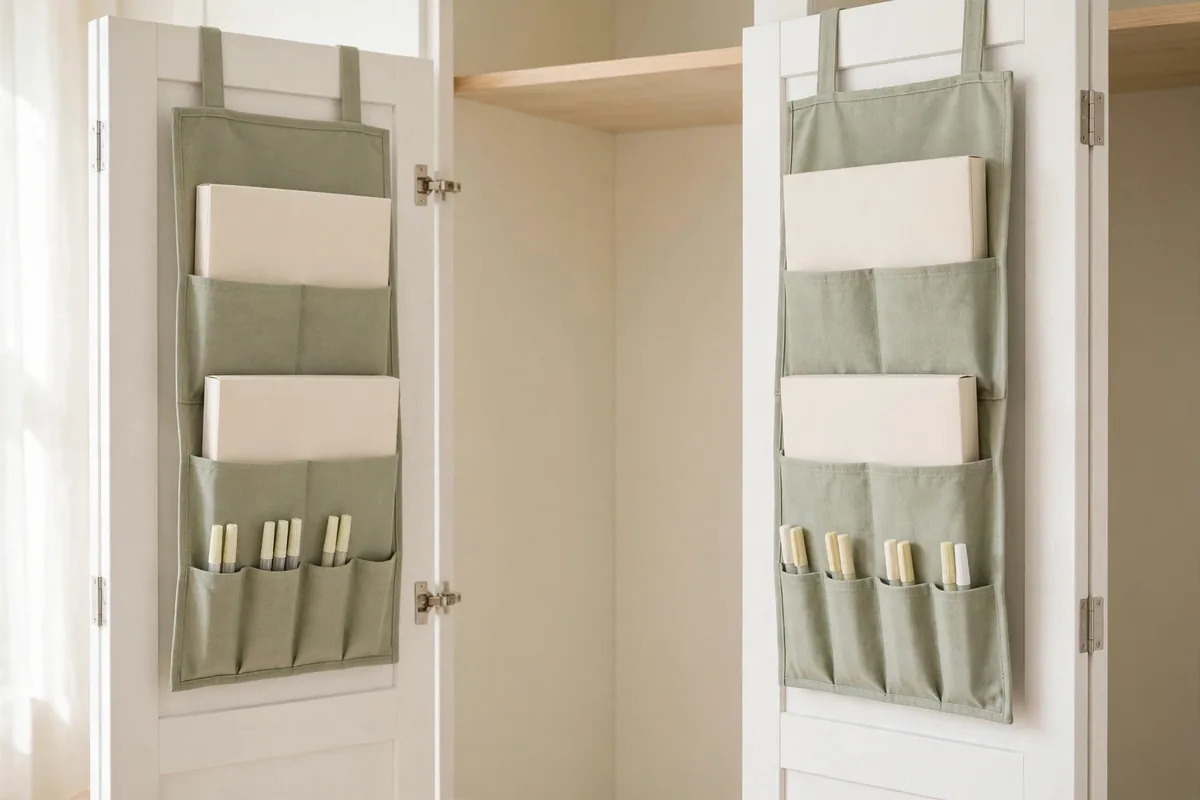
Bi-fold closet doors have inside faces that take slim organizers beautifully. A narrow over-door rack or a set of adhesive caddies ($10 to $15) on each door panel holds dryer sheets, stain pens, and the lint roller. The supplies ride on the doors and stay out of the machine zone entirely.
Keep the weight low and the profile slim. Bi-fold doors hang from a track, and heavy organizers make them drag and jump. Light items only, and test the fold several times after installing to make sure nothing catches.
Add felt pads where organizers meet the door. Bi-fold panels knock together when they fold, and two felt pads per panel silence the clatter. It is a two-minute job that makes the whole closet feel better built than it is.
A Pull-Out Bar for Air-Drying
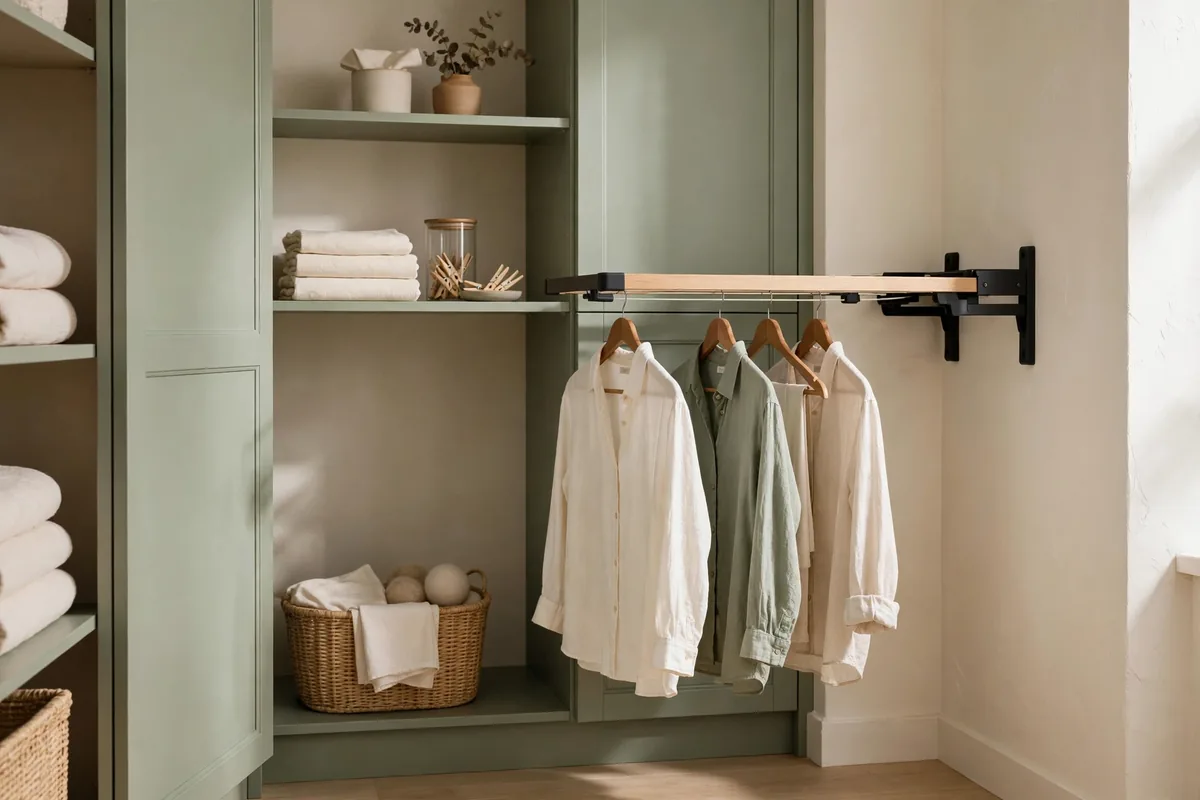
Stacked setups leave no room for a drying rack, but a pull-out or wall-mounted bar ($15 to $25) in the closet gives delicates a place to hang. Mount it on the side wall at chest height, or use a tension-mounted bar across the closet if the width allows. Pull it out for wet items, push it back when done.
Hang shirts on hangers from the bar rather than draping them. They dry faster, wrinkle less, and go straight to the bedroom closet. Keep two or three spare hangers on the bar permanently so the system is always ready.
Do not overload it. A closet bar is for the delicates load, five to eight items, not for air-drying everything you own. Heavy wet items belong on a proper rack elsewhere; the bar is a convenience, not a workhorse.
Wipe the bar down occasionally. Drying bars collect detergent residue and dust, which transfers to clean clothes. A damp cloth every month or so keeps it from undoing the wash.
Reach the High Controls Easily
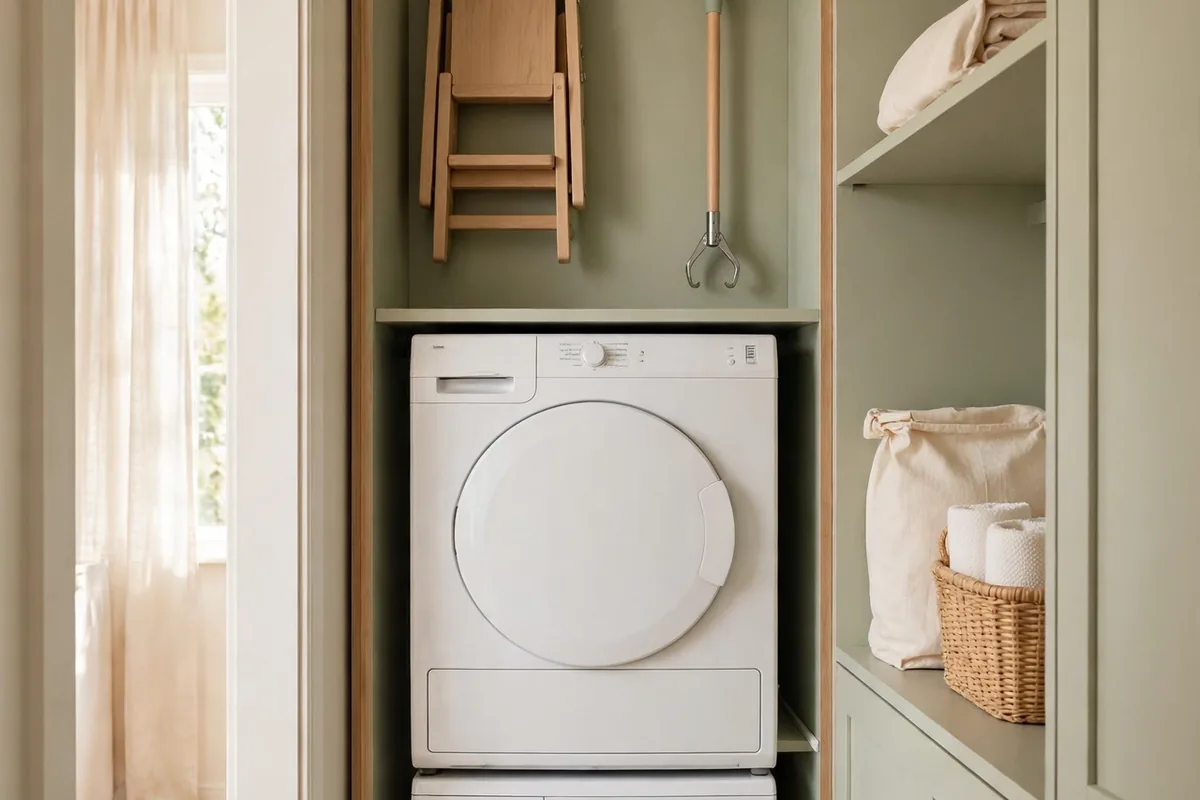
Stacked dryers put the controls at the top, which is fine unless you are short, and then it is a daily annoyance. A slim folding step stool ($20 to $30) that lives in the closet’s side gap solves it. Get the folding kind that hangs flat on a hook so it never becomes floor clutter.
A long-handled reacher ($10 to $15) earns its spot too. It fishes the sock from behind the machines, pulls the detergent from the high shelf, and retrieves whatever falls into the gap. In a closet where you cannot step sideways, a reacher is an extra arm.
Store the stool and the reacher on hooks, not on the floor. The side wall of the closet or the inside of the door takes both on simple hooks, which keeps the tiny floor completely clear. In a closet this small, floor space is sacred.
Slim Bins for Detergent and Dryer Sheets

Decant into slim containers that fit the closet’s narrow shelves — the same decant-and-label habit in our guide to organizing a small closet. Pump bottles for liquid detergent ($10 to $15), a slim lidded bin for pods, a small basket for dryer sheets. The containers should be tall and narrow rather than short and wide, matching the vertical storage a closet gives you.
Label every container. In matching decanted bottles, detergent and softener look identical, and a closet is the last place you want to play guessing games mid-load. A strip of masking tape and a marker is all it takes.
A Sorter That Actually Fits

Standard multi-bag sorters are too wide for most laundry closets. Look for a slim tilt-out hamper or a narrow two-bag sorter ($25 to $35) built for tight spaces, or hang two mesh laundry bags on hooks inside the closet door, one for lights and one for darks. Sorting still happens at the source; the container just got narrower.
If even that does not fit, sort at the bedroom. A divided hamper in the bedroom does the same job, and you carry one sorted bag to the closet on laundry day. The principle matters more than the location: no sorting marathons, ever.
Empty the sorter completely on laundry day. A sorter that never fully empties becomes a second hamper, and then you are sorting around the leftovers. All the way empty, every time, keeps the system honest.
The Closed-Door Reset
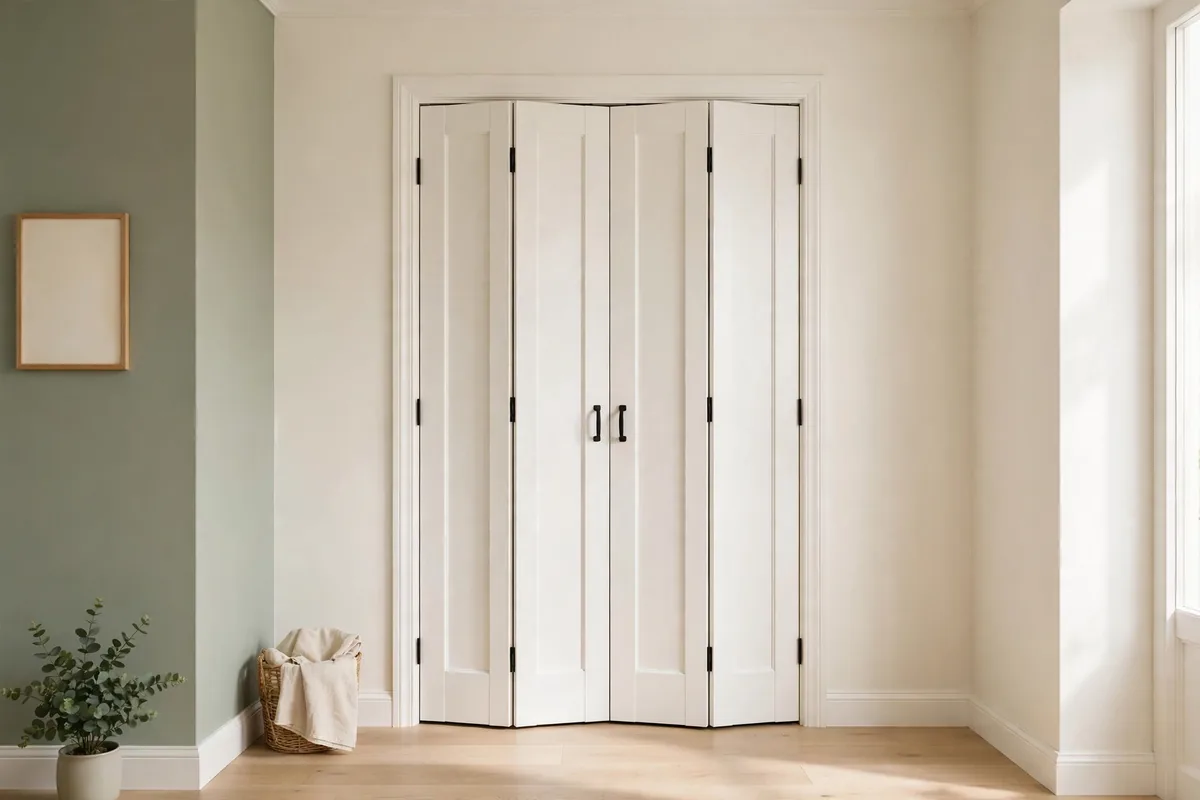
A laundry closet has one advantage over a laundry room: the doors close and the mess disappears. Earn that advantage with a two-minute reset after every load: supplies back on the shelf, the gap cart pushed in, the pull-out bar retracted, lint trap emptied. Close the doors on a closet that is actually ready for next time.
The reset matters more in a closet because there is no margin. A laundry room absorbs a stray basket; a closet does not. Two minutes after each load keeps the tiny space functional instead of letting it degrade into a machines-plus-pile situation.
Start With Measuring and the Pads This Weekend

The two moves that change a laundry closet fastest cost under $30 total: measure everything and write it down, then install anti-vibration pads under the washer. The measurements prevent every future buying mistake, and the pads make the biggest daily annoyance, the noise, noticeably better.
Then live with the measured, quieter closet for a week. You will know exactly which gap needs the cart and which wall wants the shelf, and you will buy once instead of twice.