My grandmother’s linen closet was a thing of beauty: folded sheets in crisp stacks, towels rolled like a hotel, everything smelling faintly of lavender. Mine, for years, was a single deep shelf where fitted sheets went to die. I’d open the door, reach for a pillowcase, and trigger a slow slide of mismatched linens that I’d shove back in and pretend never happened. The difference wasn’t discipline. Her closet had a system; mine had a shelf.
Small linen closets hold sheets, towels, toiletries, first aid, and the guest supplies, usually on two or three deep shelves that swallow everything. These ten small linen closet organization ideas give that shelf a system: how much to keep, how to fold it so it stays put, and how to label it so anyone in the house can find a towel without calling for help. They build on the core small-closet principles — one job per closet, measure first — with the linen-specific details below.
Purge Down to Two Sets Per Bed
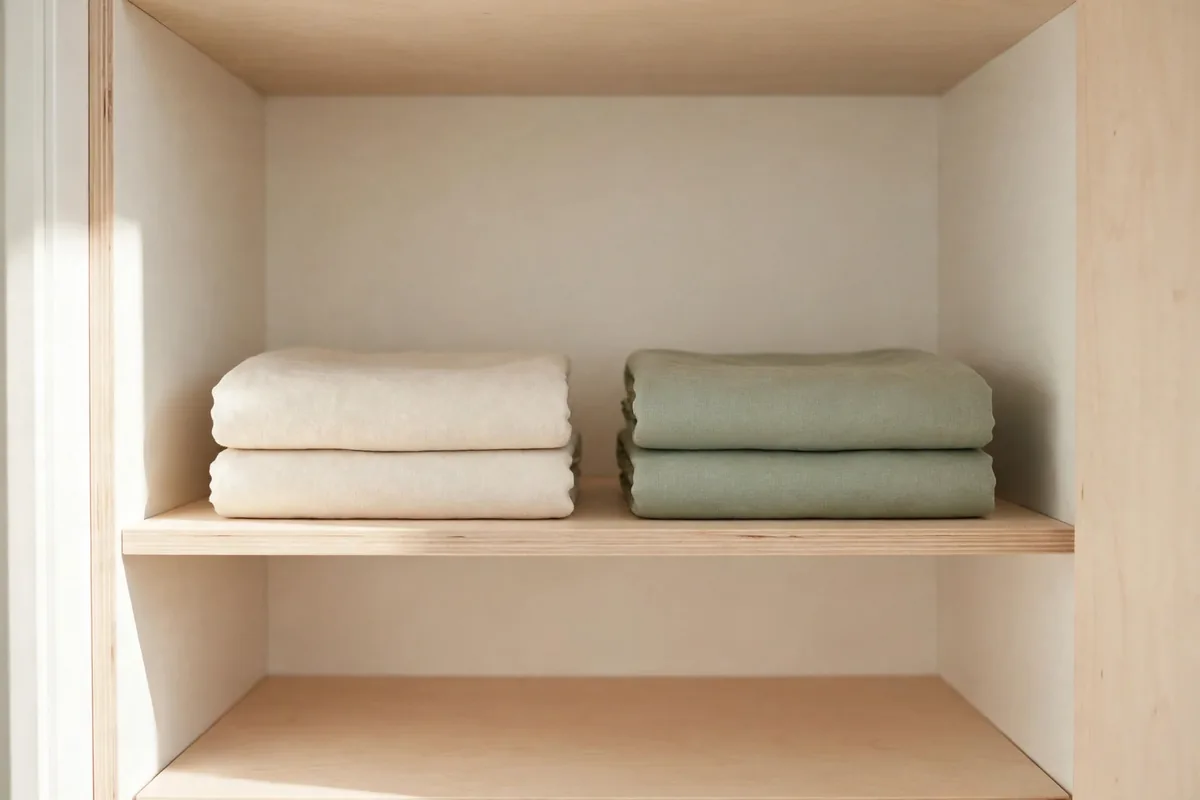
Most linen closets are overstuffed before organization even enters the picture. The rule that fixes it: two sheet sets per bed in the house, no more. One on the bed, one in the closet. The third set, the stained one, the one that doesn’t quite fit, is not a backup. It’s clutter wearing a costume.
Towels get the same treatment: two bath towels per person, plus a couple of spares for guests. Old towels with frayed edges become cleaning rags or leave the house. You will never miss them, and the closet will feel twice as big the same afternoon.
Be honest about the aspirational linens too. The tablecloth for dinner parties you haven’t hosted in three years, the twelve cloth napkins, the beach towels from a vacation era. If it hasn’t been used in a year, it doesn’t earn shelf space in a small closet.
Apply the same ruthlessness to the “good” linens you never use. The embroidered guest towels that are too nice to touch are museum pieces, not inventory. Either start using them or let them go. A small closet has no room for a collection.
Fold Each Sheet Set Into Its Pillowcase
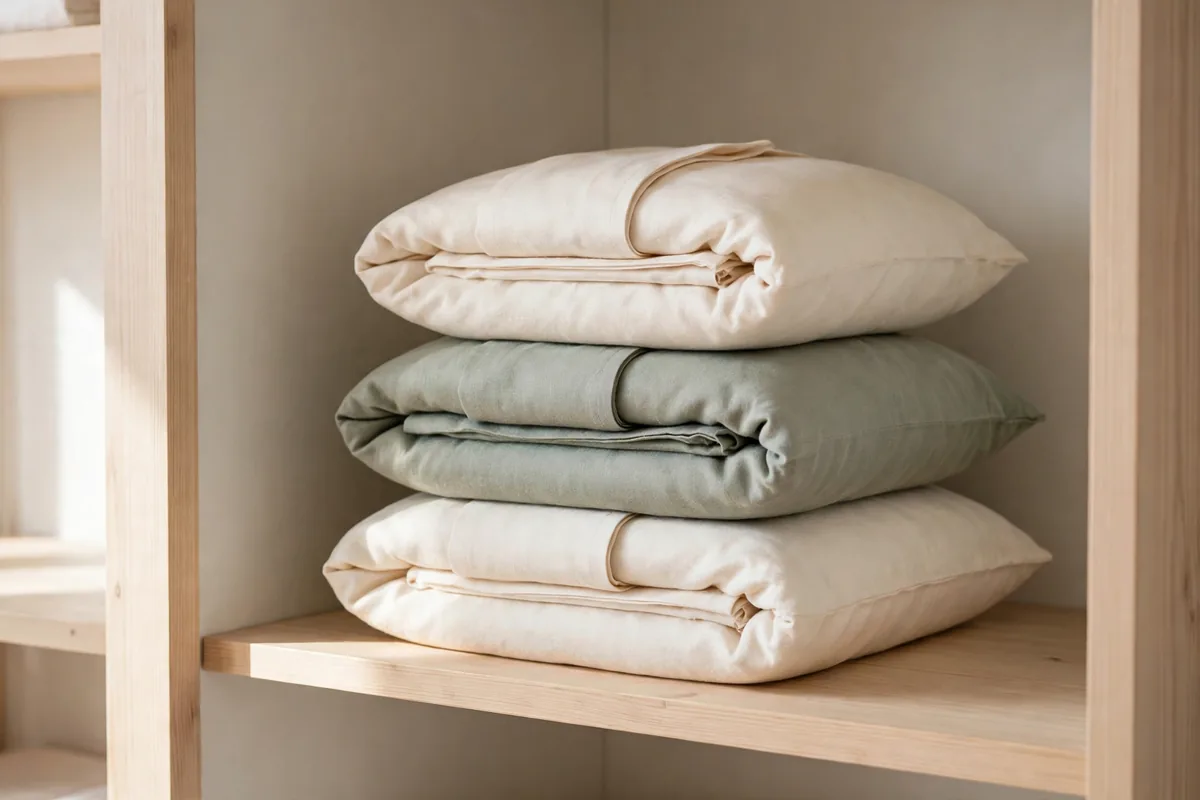
The fitted sheet is the reason linen closets look chaotic. The fix is beautifully simple: fold the fitted sheet, the flat sheet, and one pillowcase into a neat rectangle, then slide the whole set inside the second pillowcase. One tidy bundle per set, and the pillowcase keeps it from unfolding.
Stack the bundles with the open edge facing out so you can see which set is which. If the sets are different colors, even better. Grab by color and go. No more unfolding three sets to find the right one.
Teach the bundle to everyone who does laundry in the house. A system only one person understands is a system that collapses the first time someone else puts the sheets away. The pillowcase bundle takes thirty seconds to demonstrate and it sticks.
Stack the bundles by bed, not by type. All the queen sets together, all the twin sets together. When it’s sheet-changing day, you grab one bundle from one stack instead of hunting across the shelf.
Turn Deep Shelves Into Cubbies
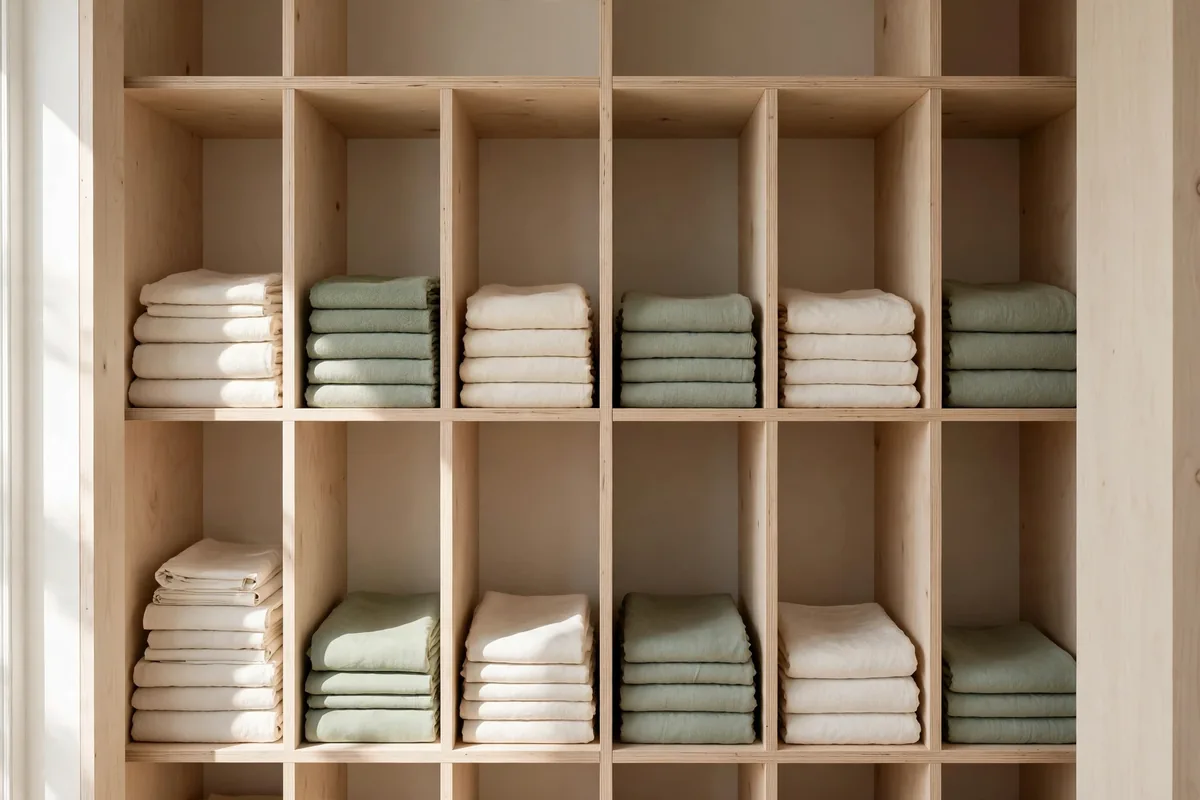
Linen closet shelves are often 14 to 16 inches deep, which is why stacks slide and topple: there’s nothing holding the sides. (Reach-in closets have the opposite problem — my shallow-bin strategy for reach-ins covers that one.) Shelf dividers ($8 to $12 for a set) split one long shelf into cubbies, and each cubby holds one category, sheet sets here, bath towels there, hand towels in the narrow one.
Dividers do something subtle but important: they set a capacity limit. When the towel cubby is full, you know you have enough towels. Without the dividers, stacks just spread sideways until the whole shelf is one continuous pile.
For wire or uneven shelves, slide a piece of cut-to-fit shelf liner or a thin board under the dividers first. Dividers need a flat, grippy surface to stay upright. A $5 roll of liner fixes every wobbly divider situation I’ve ever seen.
Leave one cubby empty on purpose. The empty cubby is landing space for the clean laundry waiting to be bundled, and it absorbs the overflow on weeks when everything comes out of the dryer at once. A system with no slack breaks the first busy week.
Roll Towels Instead of Stacking Them
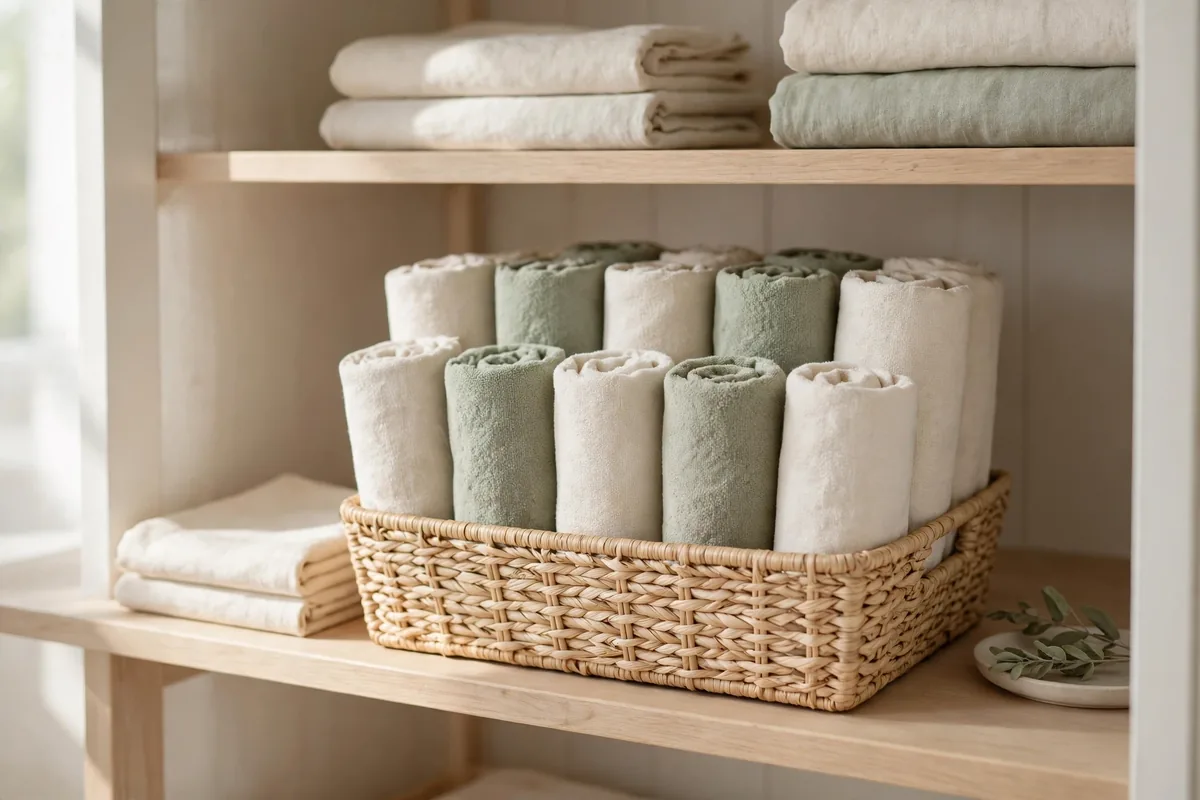
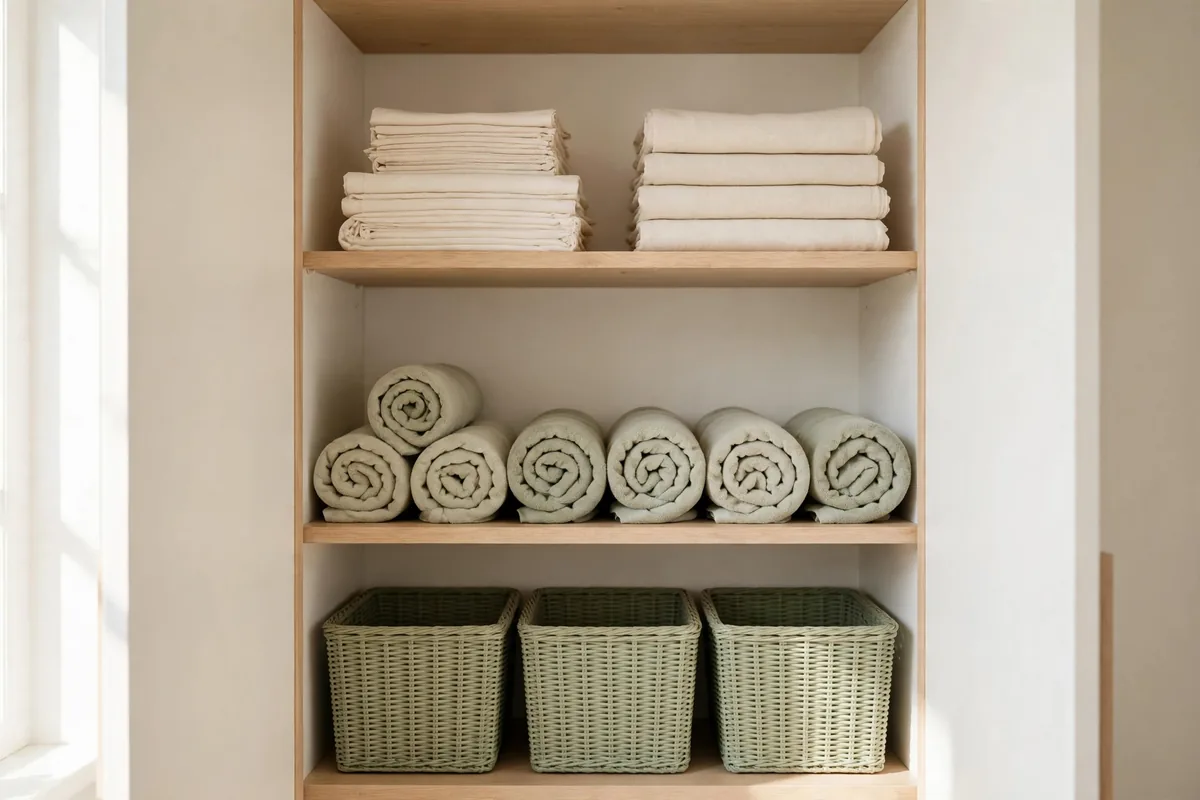
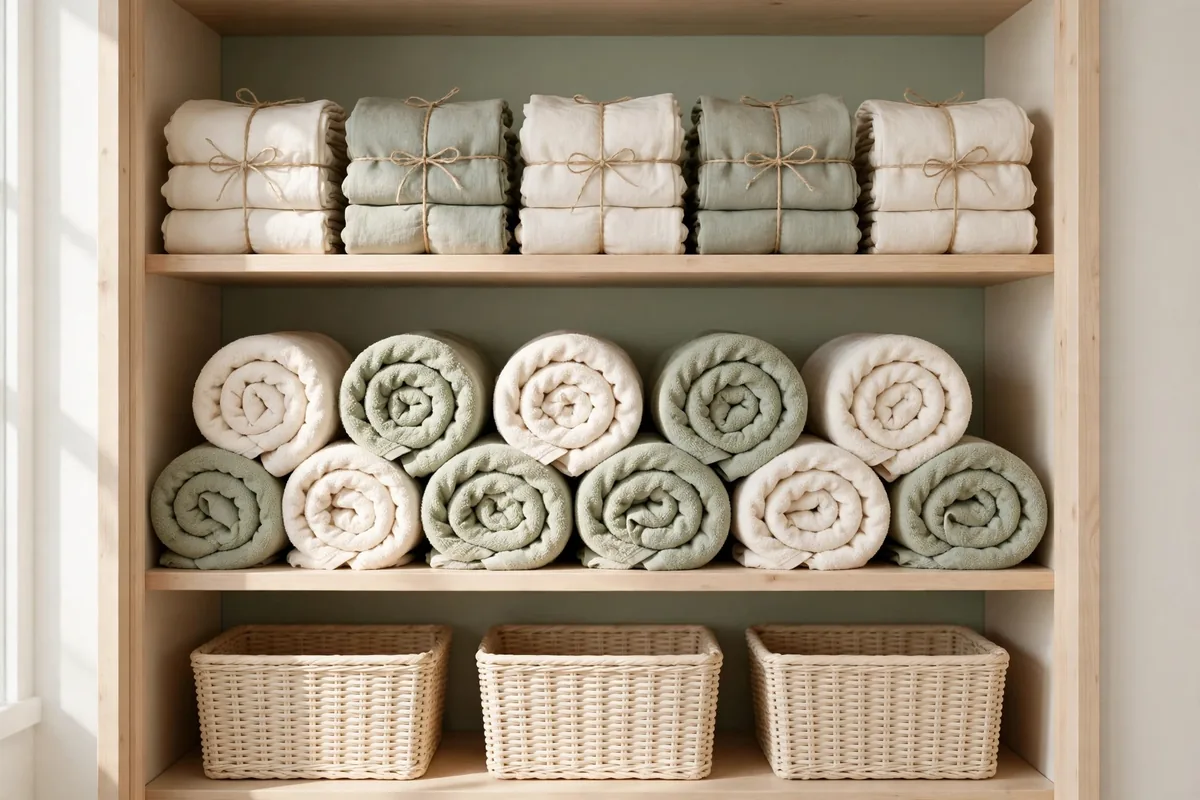
Stacked towels look tidy for exactly one day. Then someone pulls the middle towel and the stack leans. Rolled towels don’t have this problem: roll each towel into a tight cylinder and stand the rolls upright in a bin or a cubby, spa-style. Every towel is visible and grabbable without disturbing the rest.
Rolling also compresses better than folding. You fit roughly a third more towels in the same space. In a small linen closet, that’s the difference between the towels fitting and the towels living on the bathroom floor. It takes the same amount of time as folding once you get the motion down.
Stand the rolls with the loose end tucked underneath. A tucked roll holds its shape on the shelf; an untucked one slowly unrolls and goes flat. It’s a two-second step that keeps the spa look for weeks.
Label Every Bin by Category
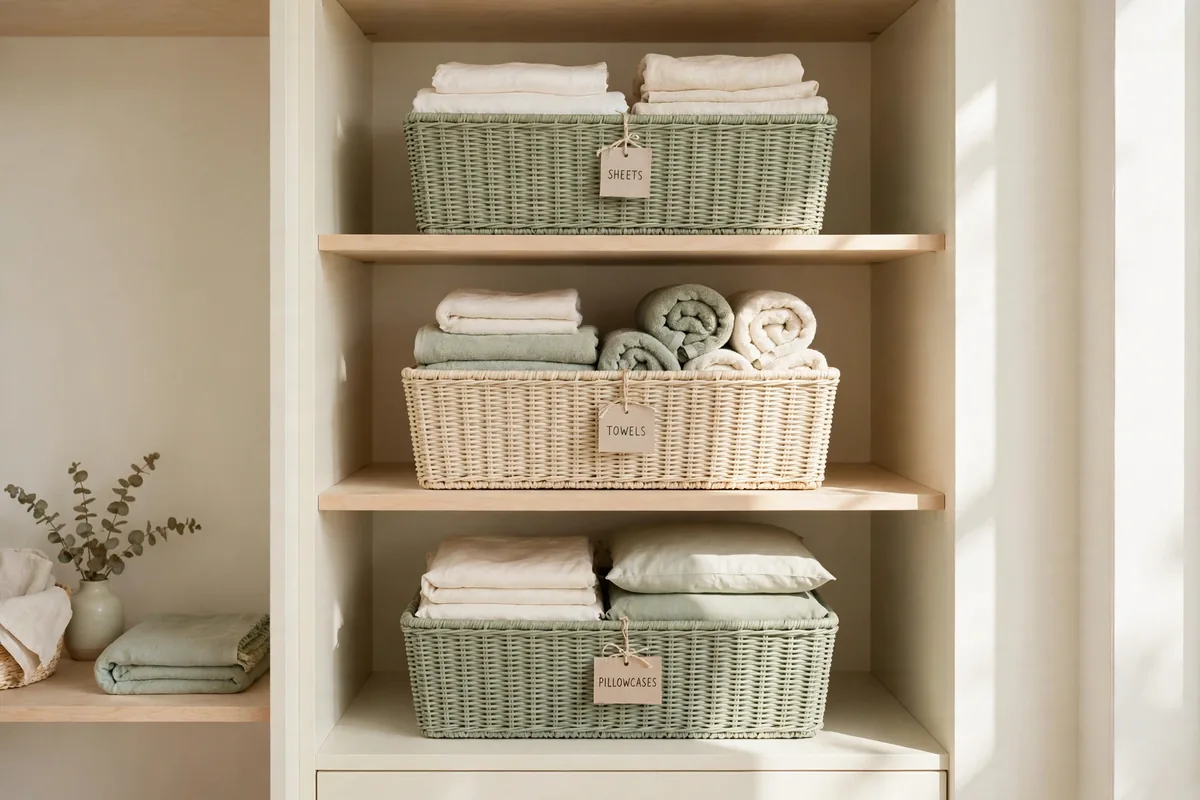
Linen closets serve the whole household, which means other people need to find things without asking you. Label every bin and every cubby by category: “queen sheets,” “bath towels,” “beach towels,” “pillowcases.” The label ends the shouted question from the hallway, “where are the good towels,” permanently. Masking tape and a marker do the job for about $3 — see labeling bins on a budget for the cheapest method that works.
Label the category, not the count. “Hand towels” survives laundry day; “6 hand towels” is wrong by Thursday. Broad, stable categories are the ones that still make sense six months from now.
Include the size on sheet labels if the house has more than one bed size. “Queen sheets” and “twin sheets” in identical bundles are a trap. The label is the only thing standing between you and putting queen sheets on a twin bed at midnight.
Date the bins that hold seasonal or infrequently used items. A small “packed Oct 2026” on the beach-towel bin tells future-you the contents are still good. Undated bins get opened “just to check,” which defeats the whole point of the label.
Give Toiletries One Stock Zone
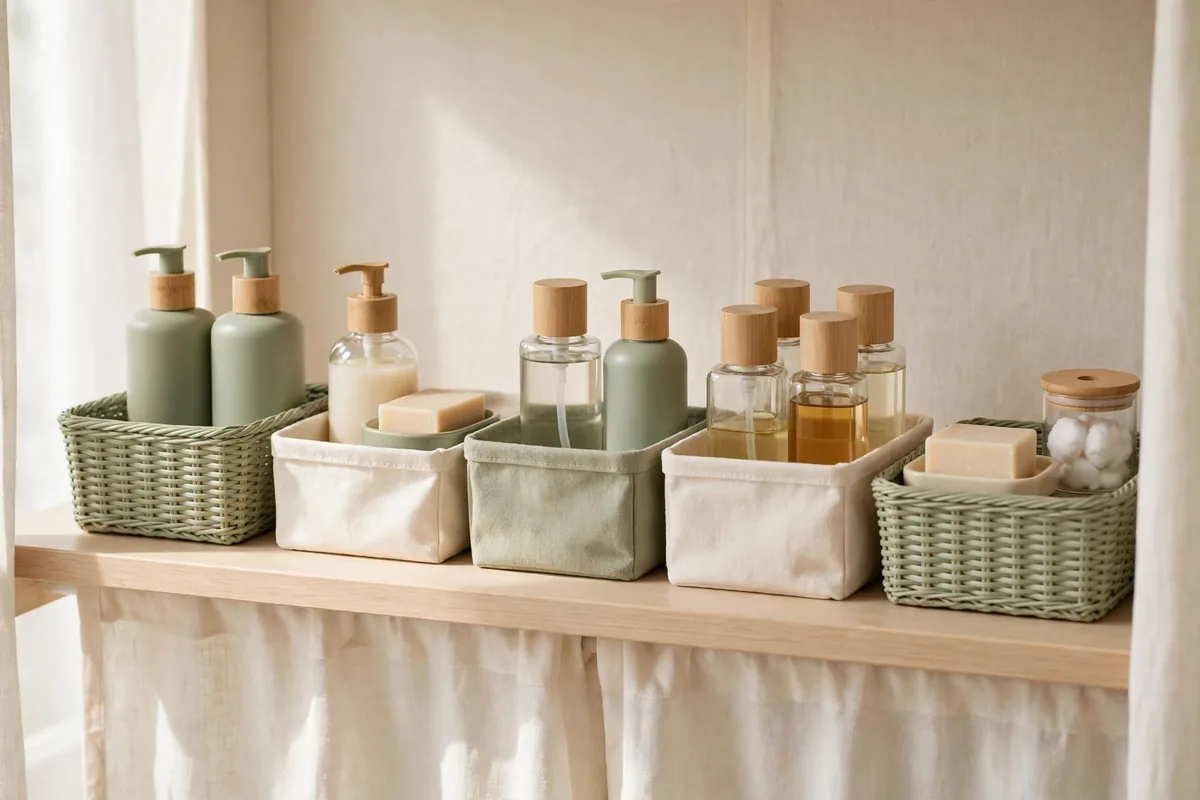
Most linen closets quietly become the household’s toiletry warehouse: the shampoo multipack, the spare toothpaste, the sunscreen collection. That’s fine, it’s actually the right closet for it, but it needs a zone instead of a sprawl. Dedicate one shelf or one section of a shelf to toiletries stock.
Decant into small bins by type: one for bath and body, one for dental, one for first-aid-adjacent items like bandages and thermometers. When you run out of something in the bathroom, the stock zone is the one place to check, not three closets and a drawer.
Check expiration dates twice a year. Sunscreen, medications, and hydrogen peroxide all expire, and expired stock is just shelf-shaped clutter. When you restock (more on that in the last idea), toss what’s past its date.
Keep a small “refill” habit: when the bathroom bottle hits empty, the replacement comes from the stock zone that day, and the stock zone goes on the shopping list. The system only works if the bathroom and the stock zone stay in sync.
Keep the stock zone to one shelf, no matter how tempting the bulk aisle is. A stock zone that sprawls onto a second shelf is just hoarding with labels. One shelf forces honest decisions about what the household actually uses.
The Door Back Holds First Aid and Travel Kits
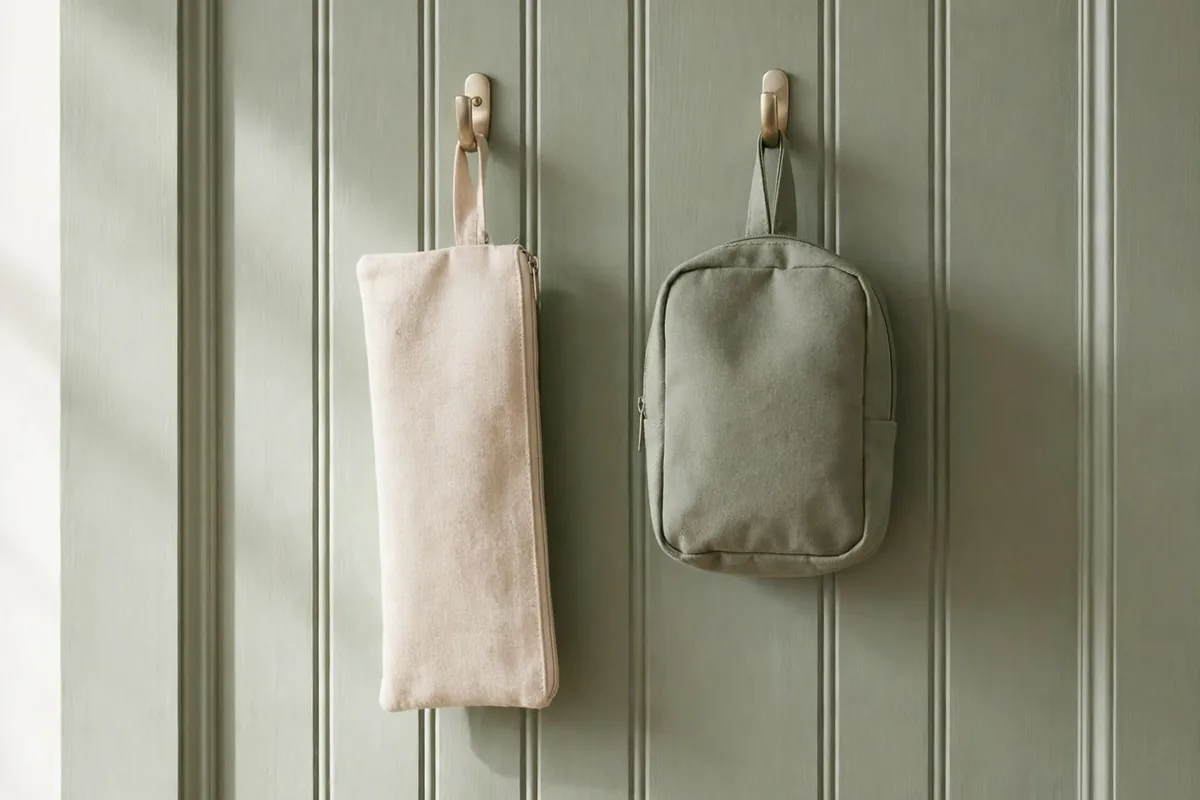
The back of the linen closet door is wasted space in most homes, and it’s perfect for the flat, light things: a slim first-aid pouch, the travel toiletry kit, a hanging organizer with nail clippers and tweezers. An over-the-door rack or a few adhesive hooks ($5 to $8) turns it into a grab zone. First aid belongs here rather than scattered across bathrooms, because emergencies don’t care which bathroom you’re near.
Check the first-aid pouch when you check the toiletry expirations, twice a year, same routine. Restock the bandages, replace the dried-out ointment, confirm the thermometer still works. One stocked pouch in one known location beats three half-empty kits in three bathrooms.
If the door is hollow-core, skip anything screw-mounted and stick to adhesive hooks or an over-the-door rack. Screws don’t hold in hollow doors, and a first-aid kit that falls at 2 a.m. is worse than no kit at all.
Keep One Shelf Guest-Ready
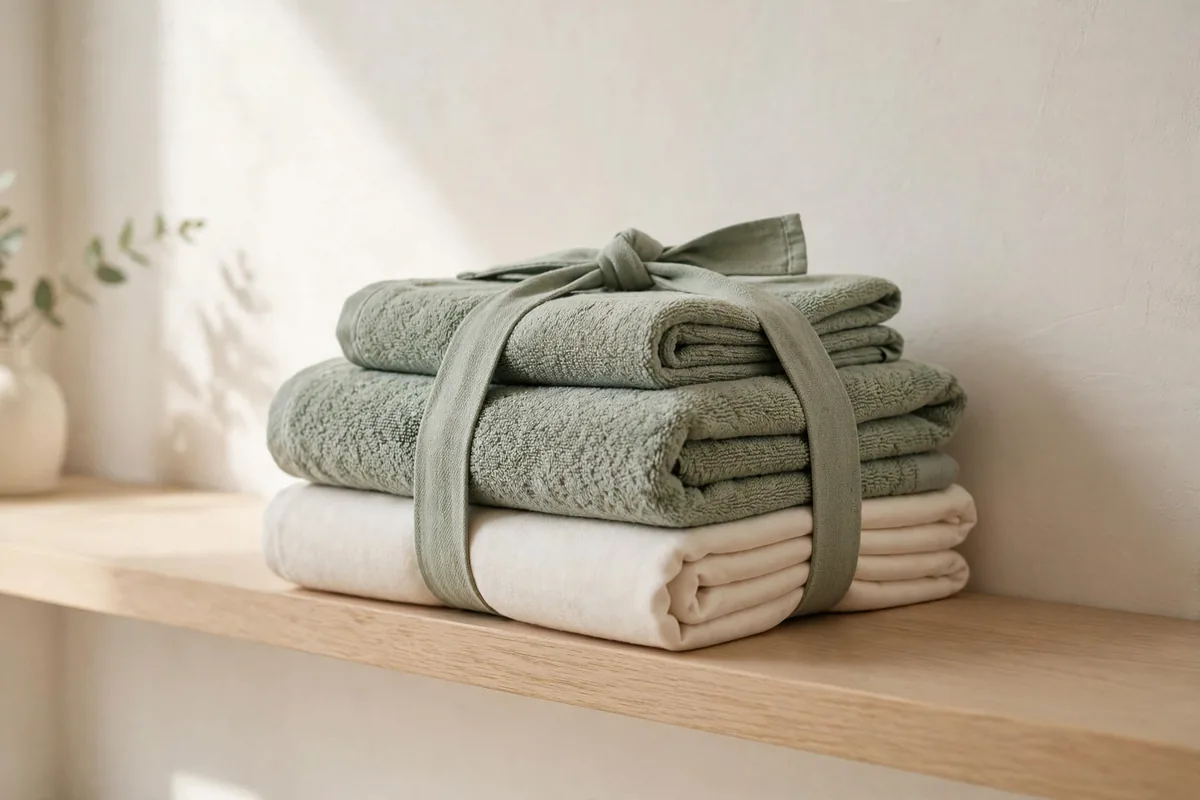
Designate one shelf, or one clearly labeled bin, as the guest shelf: a full sheet set, two towels, a washcloth, and a spare toothbrush still in its packaging. When someone stays over, you hand them one bundle instead of assembling supplies from four shelves while they wait. Pair it with the guest-ready coat closet — empty hangers and a clear landing strip by the door — and hosting gets genuinely easy.
Refresh it after every guest. Wash what was used, restock the toothbrush, fold it back into the bundle. A guest shelf that isn’t maintained becomes just another shelf, so the refresh is part of the system, not extra.
If guests are rare, the guest bundle doubles as your emergency backup set. Either way it earns its space by being complete and ready, the opposite of the usual scramble through the closet at 10 p.m.
Move Cleaning Supplies Out
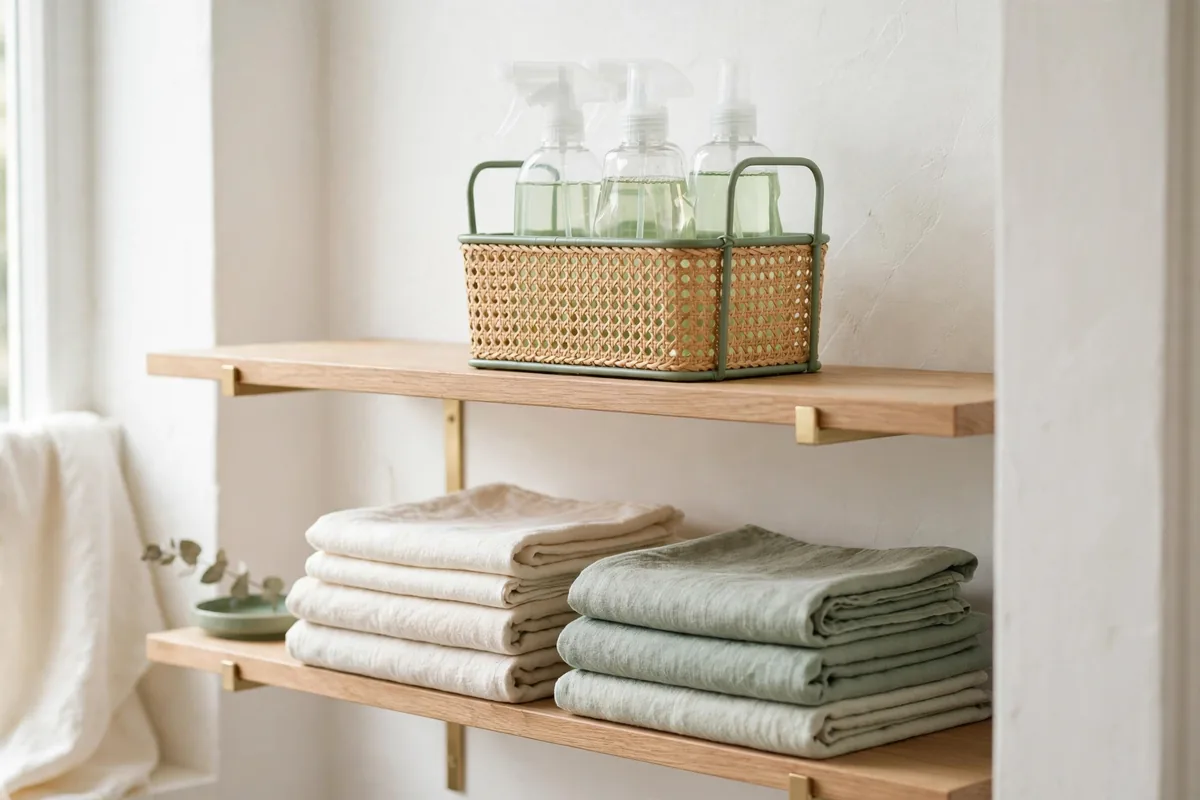
Cleaning sprays do not belong in the linen closet, even though they end up there constantly. They leak, they smell, and they take the shelf space that sheets and towels need. Move them to the utility closet, under the sink, or wherever the cleaning gear actually lives.
The one exception is a small caddy of bathroom-specific cleaners if the linen closet is the only storage near the bathroom. Even then, keep it to a caddy, contained, liftable, and easy to carry to the bathroom, not a row of bottles colonizing the shelf.
The Monthly Ten-Minute Restock
Linen closets drift faster than you’d expect: a towel migrates to the gym bag, the guest bundle loses its washcloth, the stock zone runs out of toothpaste. Once a month, spend ten minutes putting it all back. Refold the leaning stacks, return the strays, note what’s running low.
Do it on laundry day. You’re already handling sheets and towels, so the restock rides on an existing habit instead of needing its own motivation. Fold the clean laundry straight into its cubbies and bundles.
Keep a tiny running list on the inside of the door, masking tape and a marker, for what needs buying: “toothpaste, sunscreen, washcloths.” Snap a photo before the store run. The list is the difference between a restock and a guess.
This is the least exciting idea in the guide and the one that keeps all nine others working. Linen closets don’t need big reorganizations; they need ten small minutes, regularly.