I used to open my kitchen drawers the way you’d open a door in a haunted house — slowly, braced for what might fall out. The utensil drawer was a tangled nest of spatulas and mystery lids. The so-called “junk drawer” had achieved full junk status: dead batteries, takeout menus, a single chopstick. And the deep drawer under the cooktop was where good intentions went to die, somewhere behind the stack of warped baking sheets.
Then I spent one Saturday on nothing but drawers. No new cabinets, no contractor, just smart drawer storage: a $30 set of dividers and a trash bag. The difference was absurd. Cooking got faster, cleanup got easier, and I stopped buying duplicate garlic presses because I could finally see the one I owned. If you’re hunting for small kitchen drawer organization ideas that actually survive real life, these are the eleven moves that worked in my very small, very rented kitchen.
Start With a Ruthless Drawer Audit
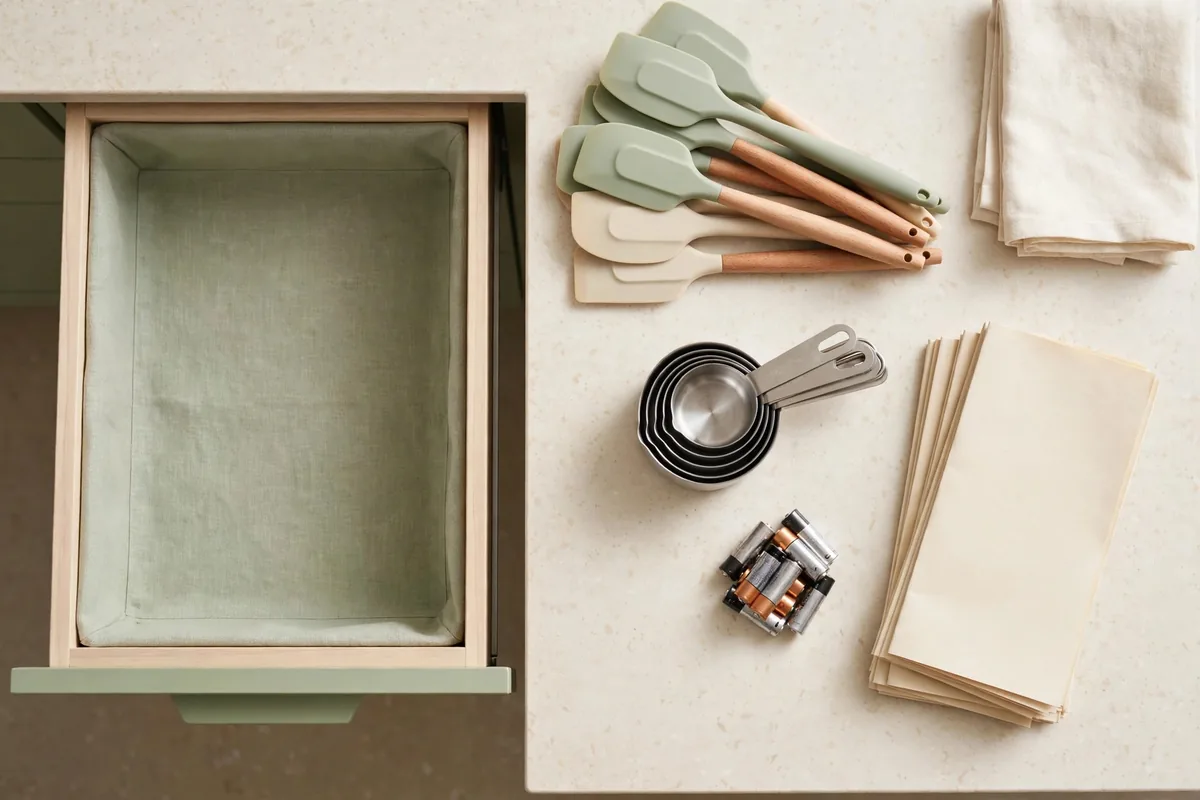
Every drawer project fails the same way: people buy organizers before knowing what they own. So empty all your drawers onto the counter at once, every single one, and sort everything into three piles: daily use, occasional use, and “why do I own this.” The third pile goes to donation or trash immediately.
In my audit I found three vegetable peelers, two sets of tongs, and a fondue fork collection I couldn’t explain. Small kitchens punish duplication because every duplicate steals space from something you actually use. Be honest about the avocado slicer. It’s okay. Let it go.
Wipe the empty drawers while they’re bare. Crumbs and sticky spots accumulate invisibly, so a quick wipe with warm soapy water, dried fully, takes ten minutes and makes everything you put back feel brand new. Line the bottoms with washable drawer liner if you want the upgrade to feel extra fresh.
Ditch the Plastic Tray for Adjustable Bamboo Dividers
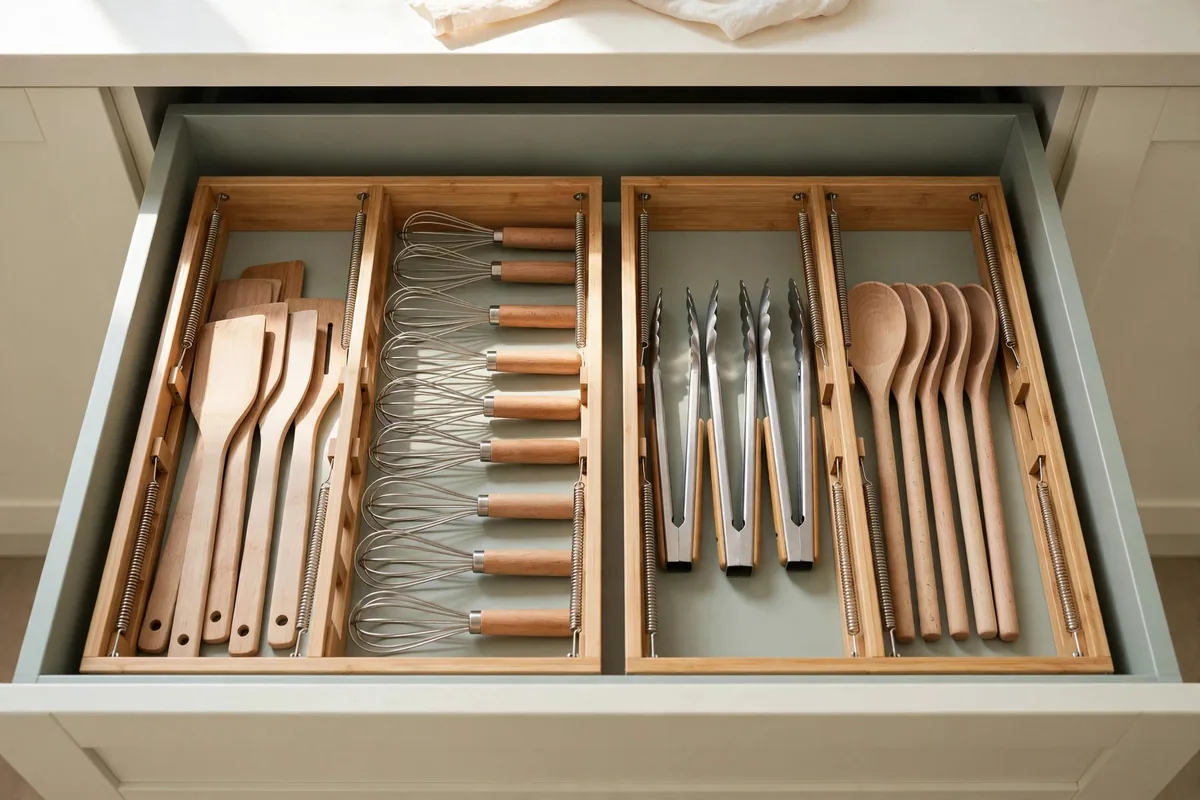
Those one-size-fits-all plastic cutlery trays are the enemy of small kitchen drawer organization. They waste the edges of every drawer and can’t adapt to odd shapes. A set of four to six spring-loaded bamboo dividers (about $18–$25) turns any drawer into custom compartments you can resize in seconds.
Bamboo wins over plastic for two reasons: it looks better when the drawer opens (which matters more than you’d think for your own morale), and it doesn’t crack when you force a slightly-too-big utensil into a slot. Rental kitchen drawers come in odd sizes, so adjustability matters more than precision.
File Deep Drawers Like a Filing Cabinet
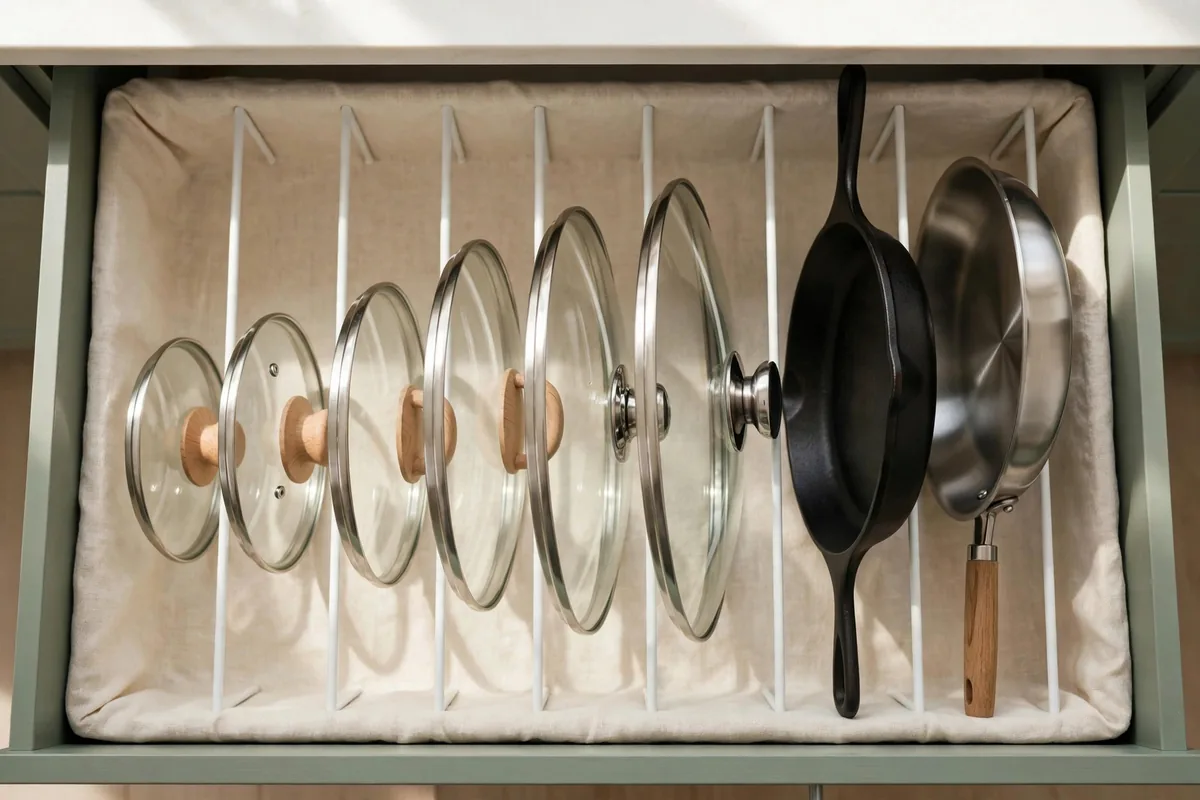
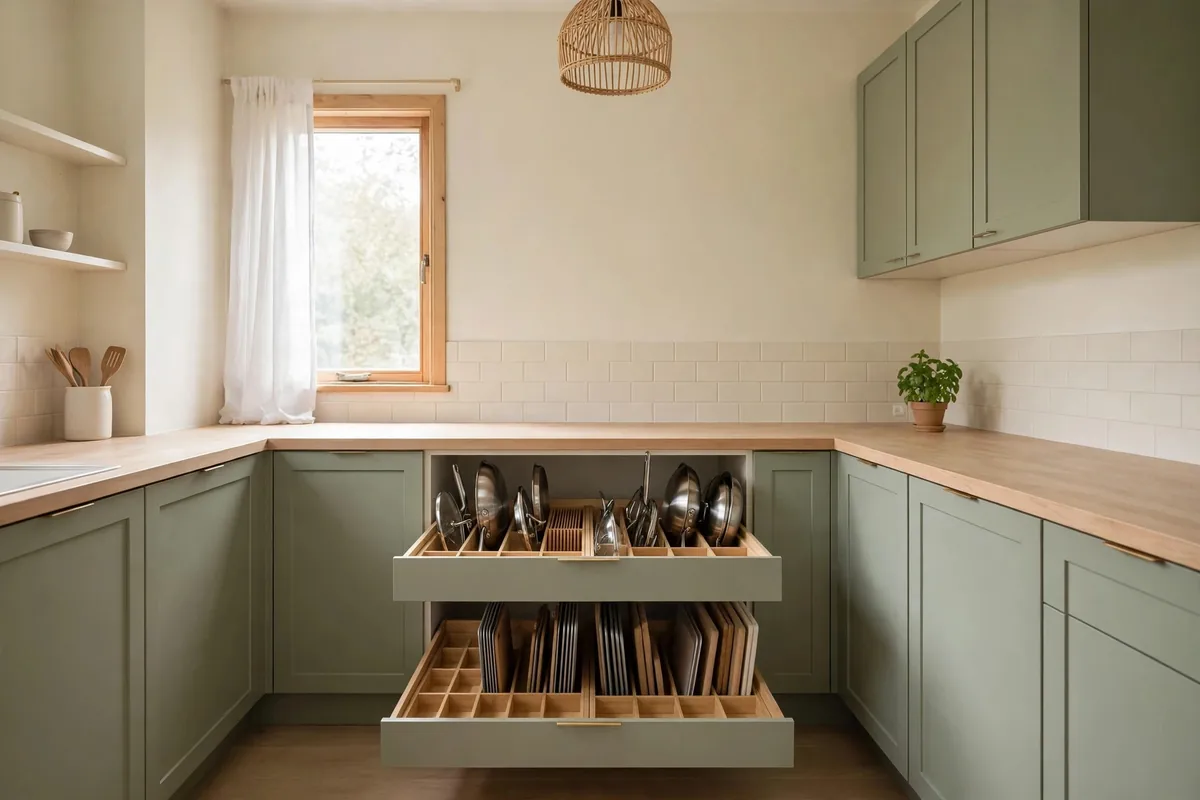
Deep drawers are the Bermuda Triangle of small kitchens: things go in and disappear. The fix for small deep kitchen drawer organization is to stop stacking and start filing. Store pots, pans, baking sheets, and lids vertically, side by side, like folders — so you can see and grab every single one without unstacking.
For lids, a simple wire file organizer or a couple of tension rods across the drawer creates slots that hold each lid upright. My deep drawer went from a clattering stack of four pans to a neat row where I can pull out the exact skillet I want one-handed. It felt like unlocking a cheat code.
A quick rule of thumb for what gets filed and what stays stacked:
- File vertically: pot lids, baking sheets, cutting boards, frying pans.
- Keep stacking: mixing bowls, colanders, anything that nests cleanly.
- Evict: the duplicates and one-trick gadgets the audit already flagged.
Flat and lidded items get the vertical treatment; nesting items can stay stacked. If you can’t see an item when you open the drawer, you stop reaching for it, so the visible slots are the prime real estate.
Rescue the Junk Drawer With a Five-Zone System
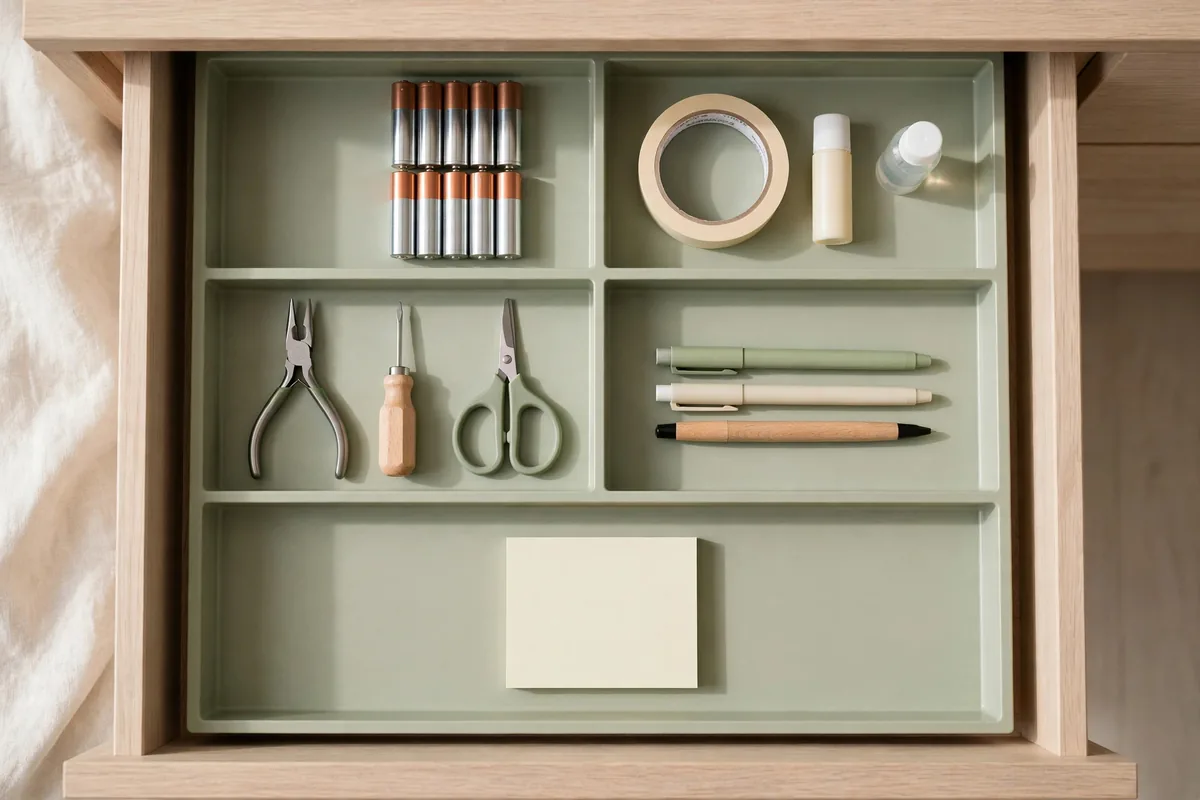
Every small kitchen has a junk drawer, and every small kitchen drawer organizing ideas list needs to address it honestly: the goal isn’t eliminating it, it’s containing it. A junk drawer with a system beats a junk drawer without one by a mile. Mine now holds exactly five categories: batteries, tape and glue, tools, notepads and pens, and one small “miscellaneous” zone.
The trick is a shallow tray with compartments — a $10–$15 desk organizer works fine — placed inside the drawer as the base layer. Everything has a designated square. When something doesn’t have a square, it doesn’t belong in the drawer, and that rule alone keeps it from reverting to chaos.
Purge it seasonally. Set a phone reminder for the first Sunday of each season: open the drawer, toss expired coupons and dried-out pens, and re-home anything that drifted in. Five minutes, four times a year, and the junk drawer stays a junk drawer instead of becoming a junk landfill.
Move Knives Into an In-Drawer Tray
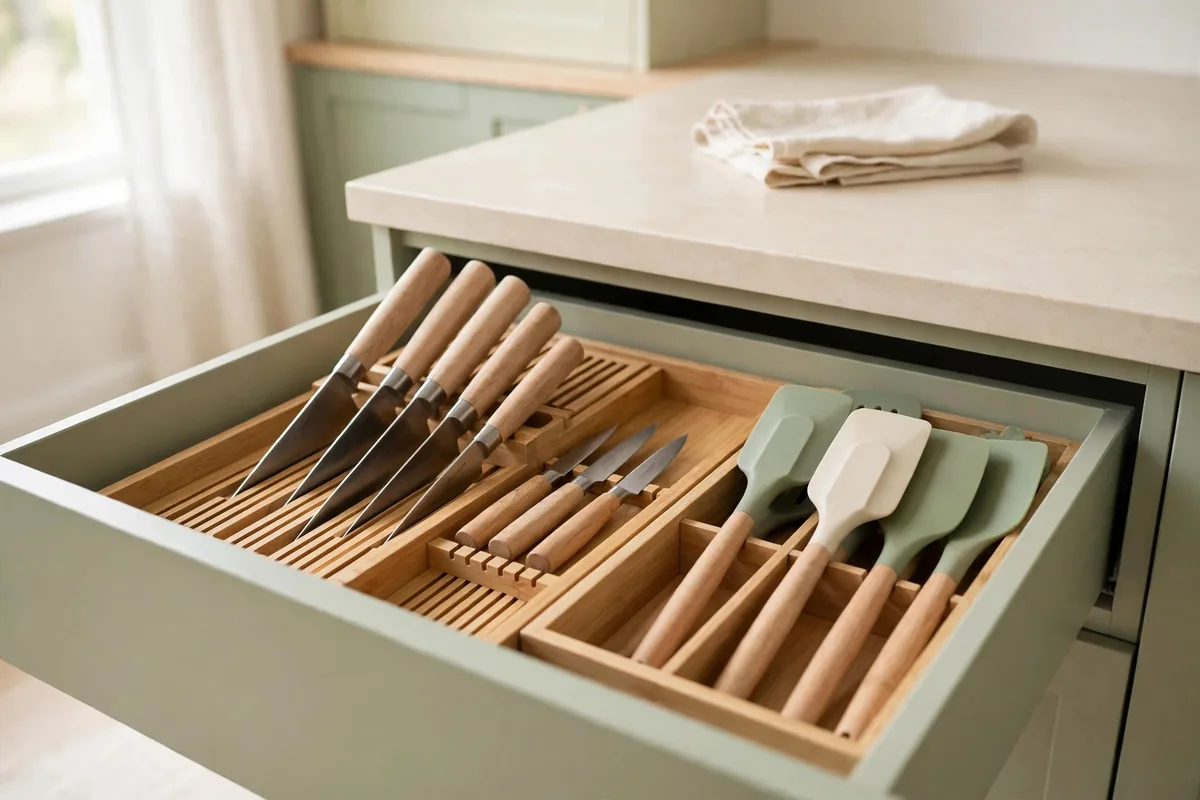
A knife block eats a shocking amount of counter space for something that holds eight knives. Moving knives into a drawer with an in-drawer knife dock (a slotted bamboo tray for about $20) frees up counter real estate and keeps blades sharper than a crowded block anyway.
Blades stored edge-down in individual slots don’t bang against each other, which means less honing and longer edge life. Measure first: the tray must fit your drawer’s interior, and the drawer must be deep enough for your longest knife (a chef’s knife needs roughly 3 inches of clearance). In households with curious kids, keep the knife drawer latched or use a higher drawer. In-drawer knives are out of sight, which is great for counters and questionable for toddlers, so know your household.
Add a Second Level With Shallow Stacking Trays
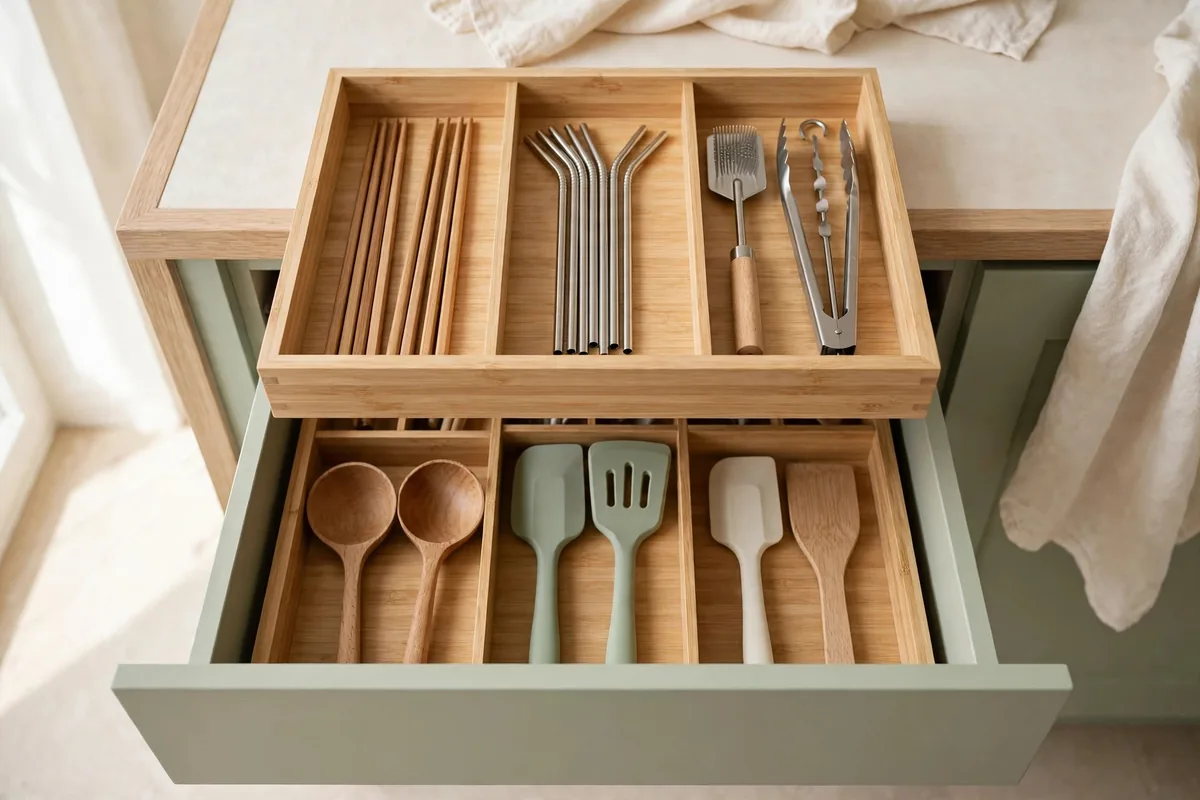
Shallow drawers have a dirty secret: half their height goes unused. Small kitchen drawer storage ideas that ignore vertical space leave money on the table. A set of shallow stackable trays, or even a low wire shelf that fits inside the drawer, creates a second level for flat items like chopsticks, straws, and grill tools.
I use the bottom level for bulky utensils like ladles and spatulas, and the upper tray for the flat small stuff that used to get lost underneath. The tray lifts out completely when I need the deep stuff, so nothing is truly buried. Keep the upper tray light and low-profile, and measure the clearance with the drawer fully closed, not just open, so it never catches on the drawer above.
Corral Measuring Cups, Spoons and Odd Gadgets
Measuring cups are the squirrels of the utensil world: they nest, they scatter, they turn up in the wrong drawer. Kitchen utensil organization in a small drawer works best when measuring tools get their own small container, a narrow bin or a section walled off by a divider, instead of floating free.
Hang measuring cups on a small hook inside the drawer if you have the depth, or stack them nested in their own little bin (keep the handles facing the same direction; aligned handles nest flatter and the section takes up a third less space). Measuring spoons go on a ring so the set stays together; the ring costs a dollar and saves the weekly treasure hunt for the missing tablespoon.
Odd gadgets like the strawberry huller, the corn holders, and the egg slicer earn their space only if you use them monthly. If not, they go in the donate pile from the audit. Small drawers punish rarely used novelty gadgets first.
Turn a Deep Drawer Into a Lid Station With Tension Rods
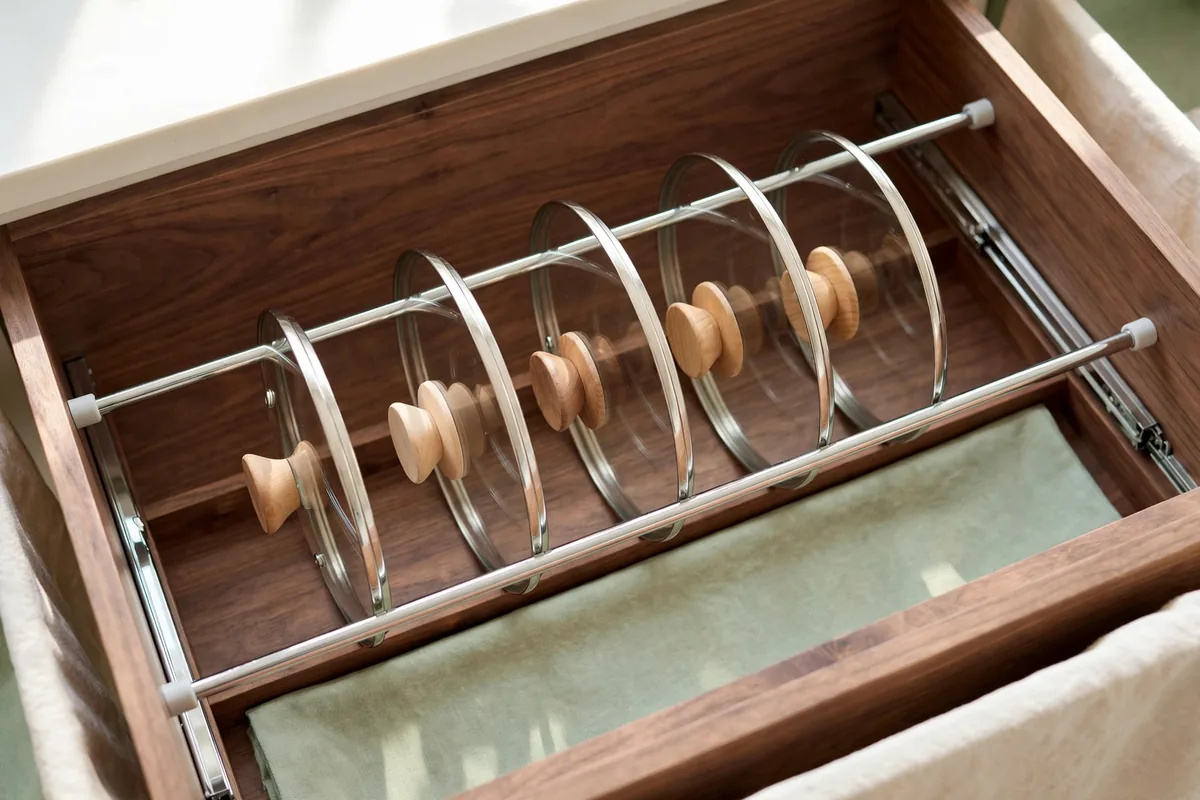
Pot lids are the single most annoying item in any drawer: round, handle-y, impossible to stack. Two or three tension rods (the spring-loaded curtain kind, about $3 each) wedged horizontally across a deep drawer create perfect vertical slots for lids of every size.
Position the rods so lids slide in at a slight tilt, handles up. Small lids go toward the front, big ones toward the back. The rods cost almost nothing, need zero tools, and come out cleanly when you move — the definition of renter-friendly.
This pairs well with the filing-cabinet method: lids in one deep drawer section, pots filed vertically in another. Open the drawer, grab the pan, grab its lid, close the drawer. Everything is reachable in one motion, which saves a surprising amount of time during actual cooking.
Lay Spices Flat in a Shallow Drawer
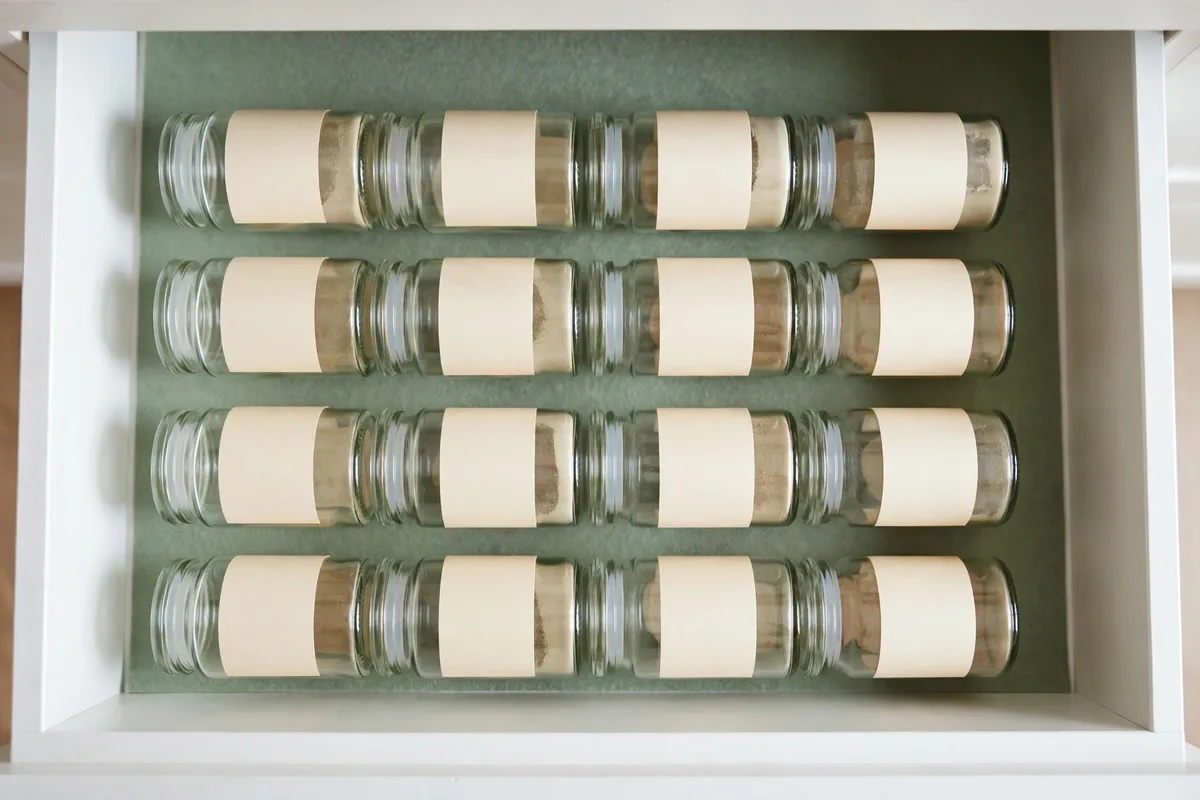
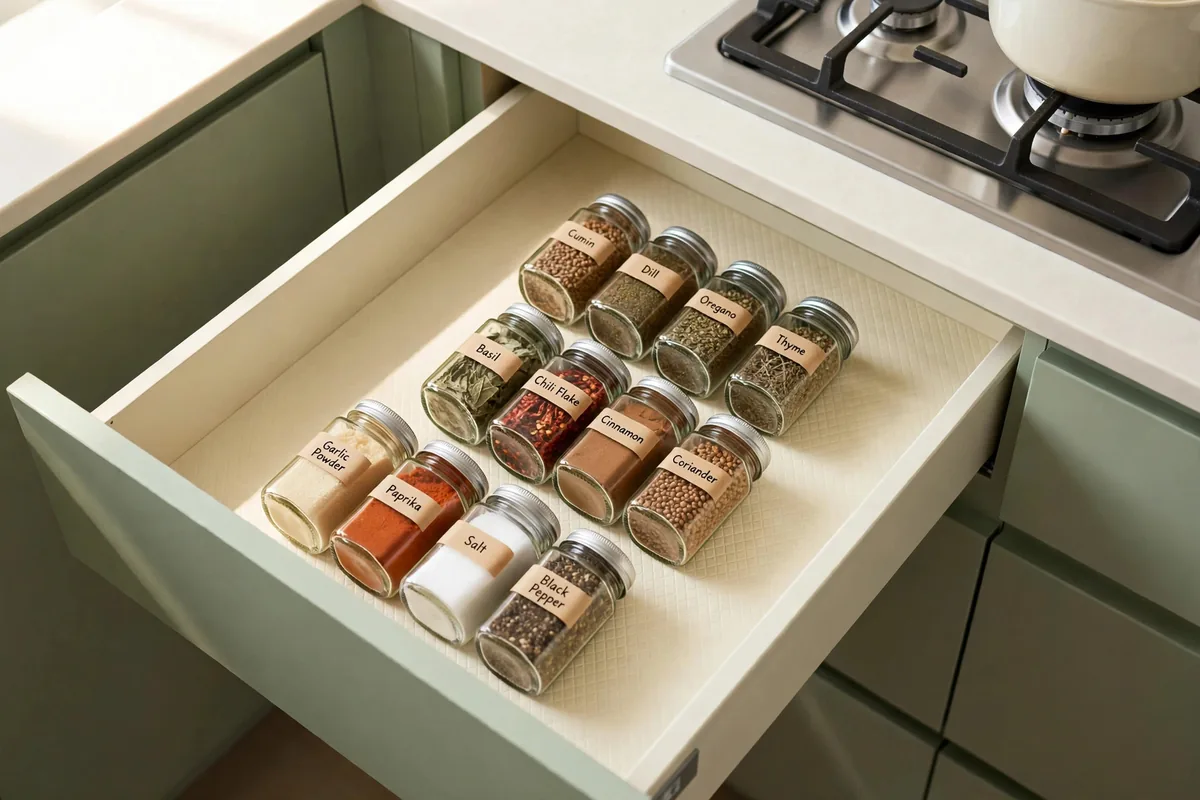
If you have a shallow drawer near the stove, it wants to be a spice drawer. Laying spice jars flat in stepped rows — labels facing up — is one of the best small drawer kitchen organization moves because you can read every label at a glance without the cabinet-door shuffle.
Use small uniform jars (the 4-ounce size is the sweet spot) and a drawer insert with angled tiers, or simply line them in rows with a strip of non-slip liner underneath so they don’t roll.
The setup takes about twenty minutes:
- Alphabetize the jars before they go in. It pays off every time you cook.
- Put everyday spices like salt, pepper, garlic powder, and your house blend in the front row.
- Relegate the twice-a-year smoked paprika to the back row.
- Decant anything that came in a bag. Bags split and leak in drawers.
Once the rows are set, the drawer barely needs maintenance. Refill a jar when it runs low and the system looks after itself.
Give Wraps, Foil and Bags Their Own Divided Drawer
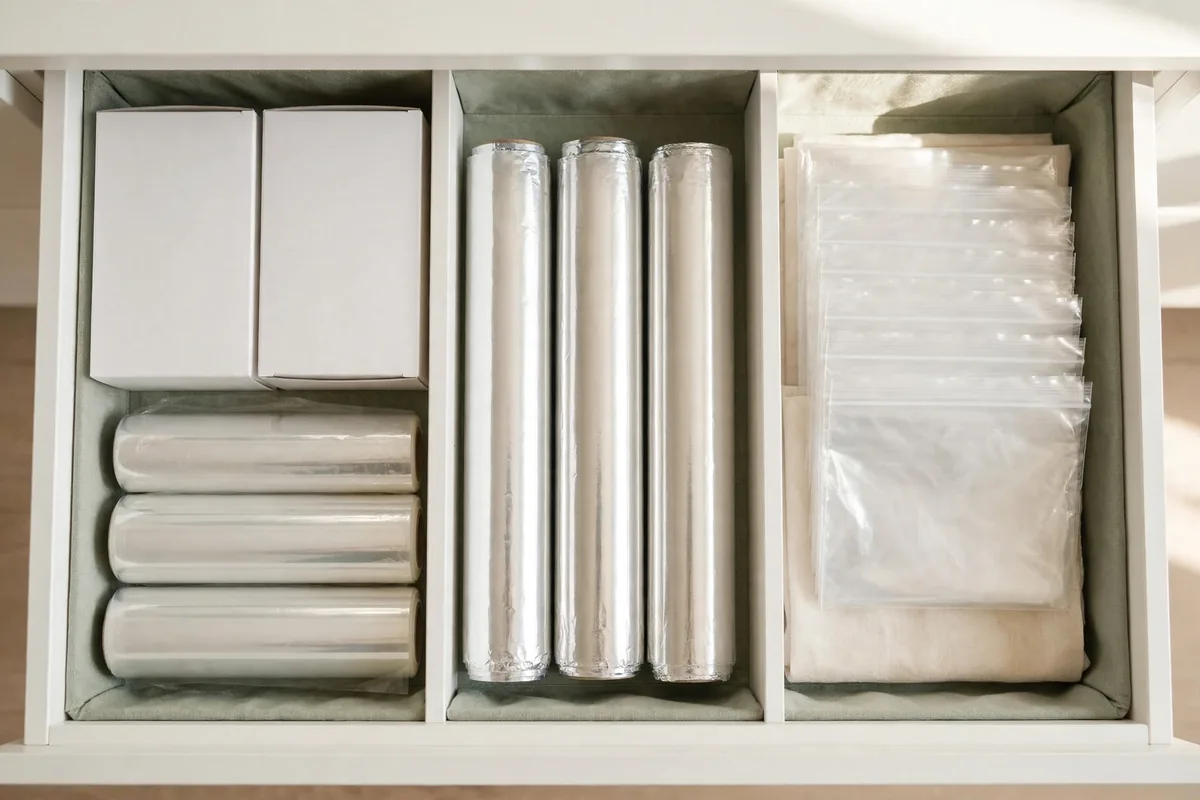
Plastic wrap, foil, parchment, and zip bags used to live in a crumpled pile in my messy kitchen cabinet. Giving them their own shallow drawer, divided with simple dividers or even cut-down cardboard boxes, turned a daily annoyance into a non-event.
Store wrap boxes on their sides with the cutting edge facing up, so you can pull and tear without removing the box. Stand zip bags upright in a row like files, sorted by size. It takes ten minutes to set up and saves a daily two-minute wrestling match. If you don’t have a spare shallow drawer, a narrow deep drawer works too. Just file the boxes vertically, because these flat, boxy items want slots, not piles.
Label the Zones So They Stay That Way
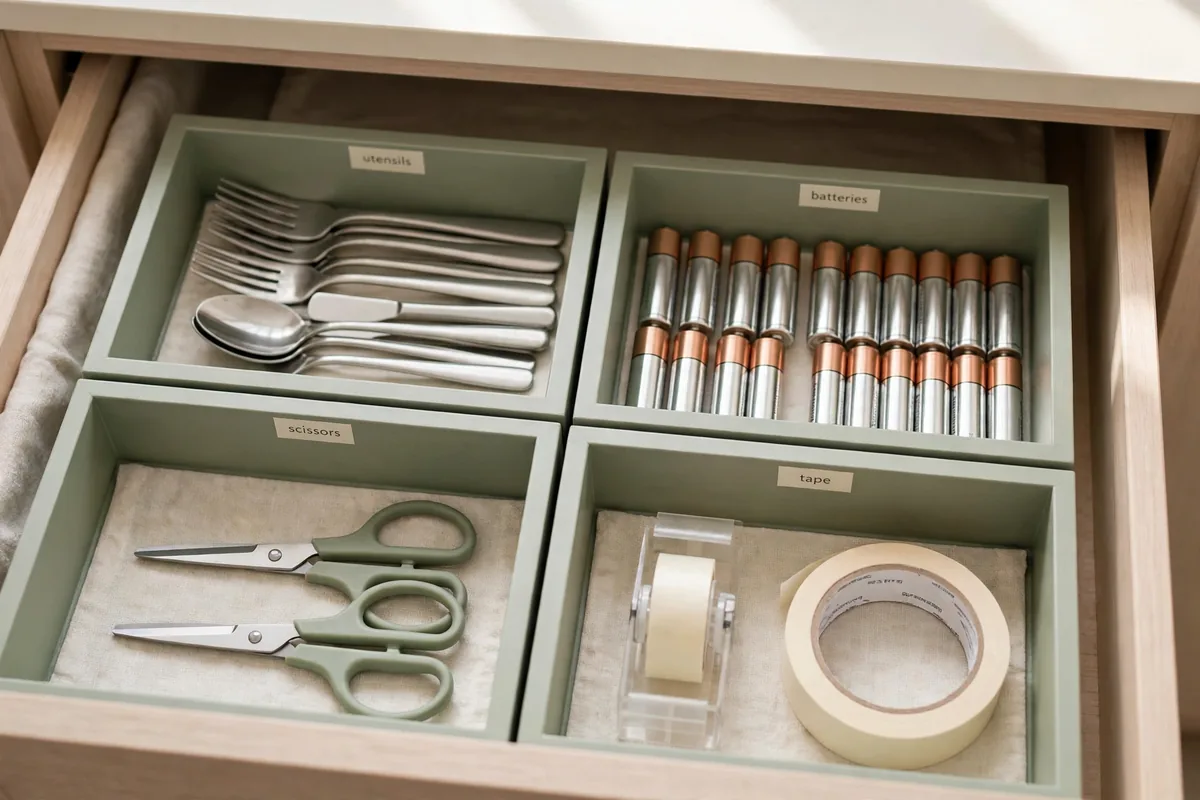
Here’s the truth nobody tells you about small kitchen drawer organization tips: the system will decay. Within six weeks, the dividers migrate and the junk drawer starts breeding. Labels are what slow the decay — a tiny label on each zone turns “I’ll just shove it here” into “oh, that’s the battery zone.”
Use a cheap label maker or simple kraft stickers. Label the front edge of each drawer (“UTENSILS,” “LIDS,” “SPICES”) and, inside, the zones themselves. It takes twenty minutes and makes the whole system legible to everyone in the house, even the roommate or partner who previously treated your organized drawer as a suggestion.
Labels also future-proof the system against yourself. Six months from now, when you’ve forgotten why the middle divider was exactly that width, the label reminds you. Once the drawers are sorted, apply the same zone-and-label thinking to organizing the whole kitchen.